Don't Fix Chapter One in November
Around Day 6 you will read back a paragraph and feel it sink. That feeling is real, it is useful, and it is on a schedule. It is also the most common way a month-long novel becomes one very good chapter.
This is adapted from Thirty Days of Writing, a day-by-day companion for the novel-in-a-month challenge. "You Hate Your Prose" is its Day 6 entry — one of thirty, each read before you write and each handing you the one tool that day usually calls for.
Sometime around the sixth day, you will read back a paragraph and feel a kind of sinking.
Not because it is broken. Because it is ordinary. The sentences are flat. The same word turns up three times. The dialogue sounds like people reading lines. It is nothing like the books you love, and nothing like the book you imagined on the first of the month.
Then a voice arrives, usually around here, and it is very reasonable. Just fix this bit first. You can't build on something this weak. Get the opening right and the rest will follow.
Take that voice seriously enough to answer it.
What it is actually proposing
The voice is not stupid. Bad sentences do have to be fixed eventually. A few writers genuinely work best polishing as they go, and their first drafts are close to finished. Momentum built on writing you despise can feel hollow.
All true. But look at what the voice is really asking for: stop drafting and start revising, on Day 6, with forty-four thousand words still unwritten.
That is the single most common way a month-long novel turns into a very good first chapter.
Why you can see the problems
Here is the thing worth understanding, because it will come back for the rest of your writing life.
Your taste is better than your drafting. That is why you can see the problems. You have read hundreds of good books; your ear knows what a good sentence sounds like; and your hands, writing at speed, cannot produce one yet. The gap between what you can recognise and what you can make is the most normal feeling in the craft.
It is not a sign that you are bad at this. It is a sign that you know what good looks like — which is exactly the thing that will make revision work. The same taste that makes today's paragraph painful is the tool you will use to fix it later.
Writing fast and writing well are two different skills. This month you are practising the first one, on purpose. You get to practise the second later, on a draft that exists.
Cheap problems and expensive ones
There is a second reason to leave the paragraph alone, and it is economic.
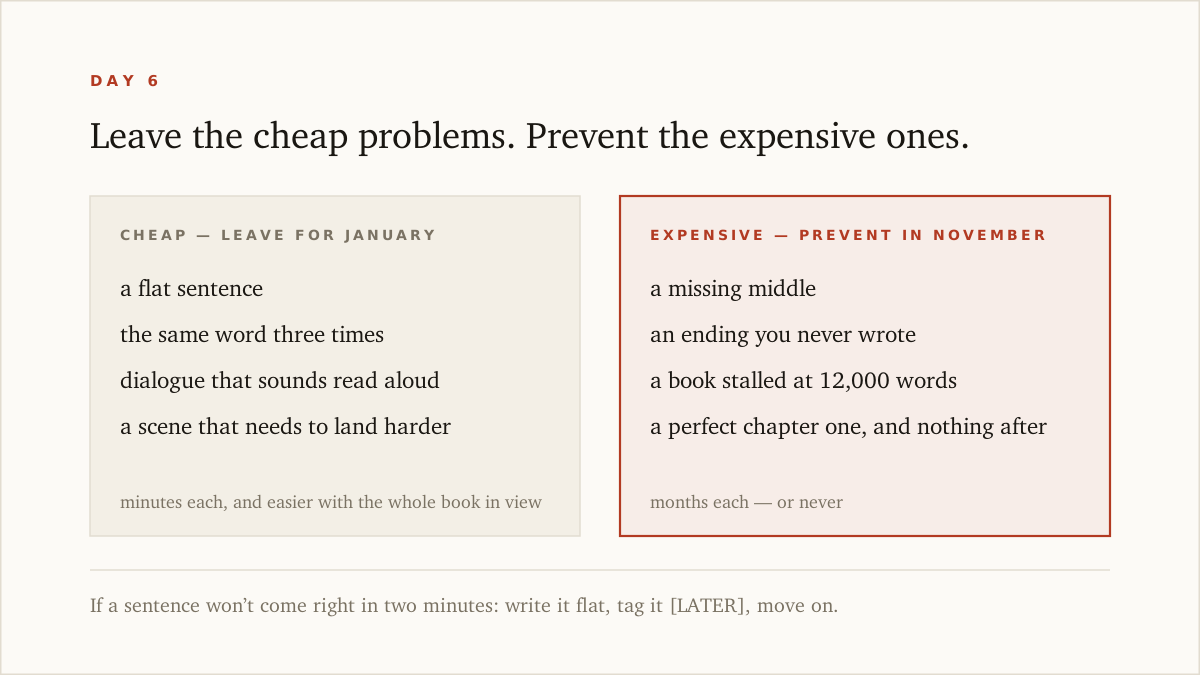
Sentences you hate are cheap to fix. A weak verb takes seconds. A flat paragraph takes ten minutes, and you will be much better at it in January, with the whole book in view, than you are now.
A missing middle is expensive. So is an ending you never wrote, or a book that stalled at twelve thousand words because the writer spent the second week perfecting the first. Those are the problems that leave novels unfinished for years.
Every evening you spend fixing chapter one in November, you are trading a cheap problem for an expensive one.
The two-minute rule
So here is the tool. If a sentence will not come right in two minutes, write the flat version, tag it, and move on.
She looked at the sea and felt sad. [LATER: this is where she understands she will lose the lighthouse — it needs to land much harder]
The tag means: this is weak, I know it is weak, and I know why. That last part matters. You are not ignoring the problem. You are filing it, with a note to your future self about what the sentence has to do. In revision that note will be worth more than any sentence you could have forced out tonight.
Two minutes is enough to try. It is not enough to spiral. When the timer in your head goes off, tag it and write the next sentence.
Is it bad, or does it just feel bad?
Sometimes the sinking is more than a bad paragraph. It is the whole thing: it's all rubbish, I'm not good at this, the book is broken. Three quick tests tell you whether that is a real problem or a feeling.
Timing. The feeling arrives on schedule — often at the same point in every project, whatever the project is. A real problem arrives when something happens: a reread that surprises you, a moment away from the desk when you suddenly see the flaw.
Scope. The feeling is global — the whole thing is broken — and there is nothing you could do tomorrow in response to it. A real problem is local. Chapter nine doesn't earn the reconciliation. Try writing the complaint down as a specific sentence about a specific place. If you can, it is real, and you have just turned despair into a task. If every attempt comes out as a sentence about you, it is the feeling.
Direction. Look hard at the thing you are afraid of. A real problem gets clearer under scrutiny. The feeling gets worse and vaguer.
Those three tests come from You Are Not Lazy, whose chapter on permission to write badly is mostly about this exact moment.
Why the opening comes last
There is one more reason to leave chapter one alone, and it is the strongest.
You cannot write your opening yet. Not because you lack the skill. Because an opening has a job — to tell a reader where they are, who they are with, what kind of book this is, and why they should keep going — and you do not fully know the answers to those questions until you have written the end.
On Day 6, you do not know what kind of book this is. You find out on Day 22, or Day 28, or in January when you read the whole thing through. The first page you write now is a guess at a book that does not exist yet. The first page you write in revision is written by someone who has read it.
That is not a failure of preparation. It is the order of the work.
What actually happens if you leave it
Most people find their prose improves a little over the month. It happens without their trying, simply because they stop stopping. The internal critic goes quiet once it learns it will not be obeyed.
By the third week, many writers are surprised to find paragraphs they do not hate. You will not get there by fixing Day 6. You get there by writing Day 7.
The book this came from
Thirty Days of Writing
When November is over and the draft exists, the opening is the right thing to go back to — and Page One is a whole book on it: the four questions a reader is asking before she will turn the page, and a test you run on your first thirteen lines.
Kindle · Paperback