The Smallest Outline That Will Get You Through a 30-Day Novel
Not an outline. One ending, three turns and about forty lines — two sides of a sheet of paper, one evening, and enough to stop you getting lost on Day 9.
This is adapted from Thirty Days of Writing, a day-by-day companion for the novel-in-a-month challenge. Five short chapters for the week before you start — this is the second — then one entry for each day of the month.
Most ideas that feel irresistible in October are dead by the ninth of November.
Not because they were bad ideas. Because they were a particular kind of idea — the kind that is entirely a situation. A lighthouse keeper finds a door in the rock that was not there yesterday. Two rival bakers are forced to share a kitchen. A detective who cannot remember faces.
Each of these is a lovely opening. Each gives you a week of writing, maybe more, on pure energy. And then, somewhere in the second week, you run out of situation. The door has been found, the bakers have met, the detective has failed to recognise someone. You sit down to write and realise you do not know what happens next.
You are not blocked. The idea never contained a next.
A situation is where a novel starts. A novel is a series of changes. The job before 1 November is to find out whether your idea has changes in it — and then to draw the smallest map of them you can draft from.
The ten-scene test
Take a sheet of paper and list ten scenes from your novel that you actually want to write.
Not ten events. Not ten themes. Scenes: a specific moment, specific people, something happening. She opens the door and the stairs go down, not up. The bakers sabotage each other's sourdough the night before the judges arrive. The detective interviews the killer and does not know it.
You are not committing to these. Several will change. What matters is whether you can reach ten.
If they come easily and you find yourself on fourteen, your idea has changes in it. It is a novel.
If you stall at four, it is still a premise. That is fine — you found out tonight instead of on Day 9. Spend the time you would have wasted asking the premise one question, over and over: and then what goes wrong?
Two things usually get a stuck list moving.
A character who wants something you could photograph. "She wants to be happy" cannot drive a book, because nothing in a scene can move towards it or away from it. "She wants the lighthouse deed back in her family's name before the auction on the first of the month" can. Every scene either brings her closer or pushes her away.
A genre with a known shape. A mystery already knows it needs a crime, suspects, false leads and a reveal. A romance already knows its two people have to meet, resist, fall, break apart and choose each other. A thriller already knows there is a clock. If this is your first finished novel, a genre is not a limit. It is scaffolding you do not have to build yourself.
The minimum map
Three parts. None of them is prose.
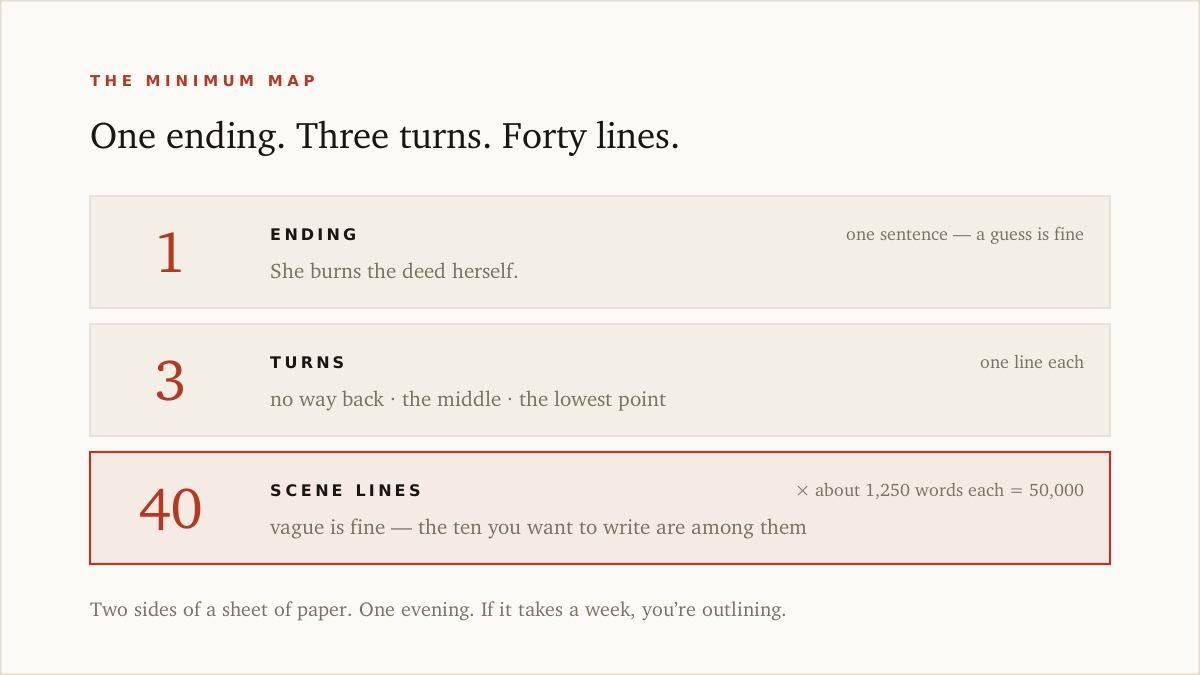
One ending, or a guess at it. One sentence. She burns the deed herself. The bakers open a shop together. Discovery writers resist this part most, so here is the reassurance: it is a guess, and you are allowed to be wrong. You are not allowed to have no destination at all, because a draft without one does not wander towards an ending. It just wanders.
Three turns. The moments where the story changes direction, one line each:
- the point where the protagonist commits and cannot go back
- the middle, where something is revealed or reversed that changes what the story is about
- the lowest point, just before the end, where everything seems lost
About forty scene lines. Here is the arithmetic. If you are writing the complete story in November, forty scenes at an average of about 1,250 words each is fifty thousand words. You do not need forty good lines. You need forty lines, each naming a scene, in roughly the right order, with your ten from the test among them. Many will be vague. That is what they are for.
If you are writing the first part of a long book instead, write the whole book in ten lines so you know where your part sits, then about thirty scene lines for the stretch you are drafting this month.
That is the map. It fits on two sides of a sheet of paper and it should take one evening. If it is taking a week, you are outlining — which is a fine thing to do, at another time.
If the three turns will not come
Borrow a structure. The most useful one for this job is Dan Wells's seven-point structure, which he adapted from a role-playing game guide and has taught for years: hook, first plot turn, first pinch, midpoint, second pinch, second plot turn, resolution.
The part worth stealing is not the list. It is the order he builds it in.
- Start with the resolution. Decide where the story ends up.
- Write the hook as its opposite. If she ends up burning the deed, she starts out believing the deed is the most important thing in the world.
- Find the midpoint — the moment that moves her from one belief towards the other.
Those three alone are often enough to give a discovery writer a skeleton to hang the discoveries on. The pinches and turns tend to suggest themselves as the steps needed to get from one point to the next.
One more line, if you want the book to last
Here is a test borrowed from a different problem, and it costs two minutes. Under your ending, write two questions:
- What does this book ask? — the thing a reader wants to know, answered by the end.
- What does this book refuse to settle? — a question about people, which two readers could answer differently.
You do not need the second one to finish in November. But a book that has it is the kind people press on each other afterwards, and it is much easier to keep a question open on purpose than to discover in revision that you closed it by accident. There is more on that in What Is Upmarket Fiction?.
The map is a note, not a contract
Your characters will not follow this map. By Day 4 one of them will have done something you did not plan.
That is the point of having one. The map is not there to stop the story changing. It is there so that when the story changes, you can see what changed — and still know roughly where the ending is.
The book this came from
Thirty Days of Writing
The book picks the map up again on Day 4, when the story first leaves it, with a five-minute way to update the map and keep going — and on every day after where the story's position matters.
Kindle · Paperback