Behind on Your Word Count? Do the Arithmetic, Not the Panic
Nobody quits a month-long novel because they fell behind. They quit because of the plan they made for catching up. Here is a better one, and it is mostly division.
This is adapted from Thirty Days of Writing, a day-by-day companion for the novel-in-a-month challenge. The catch-up arithmetic is its Day 10 entry; the revised finish line is Day 20; and there is a card at the back for one, three and five-plus missed days.
Most people are behind by the tenth of November. If you are not, read this anyway, because you might be by the twentieth.
Falling behind is not the problem. Everyone falls behind. A cold, a deadline, a child's birthday, one evening where the sentences would not come — the month does not care, and nor should you.
The problem is what happens next.
How being behind turns into quitting
It almost always goes the same way.
- You miss a day, or write four hundred words instead of sixteen hundred.
- The next day you tell yourself you will make up the gap, so tonight's target is not 1,667 but 3,334.
- That is a lot. You do not quite manage it.
- Tomorrow's target is now five thousand. And five thousand words in an evening after work is not a hard number. It is an impossible one.
Faced with an impossible number, a perfectly sensible person stops. Not because they cannot write. Because the plan now demands something nobody could do, and the only way to stop failing at it every evening is to stop.
The mistake is never falling behind. It is planning to recover the whole deficit in one sitting.
Spread it
The fix is arithmetic, and it is almost embarrassingly simple.
Take your deficit. Divide it by the days you have left. Add that to your daily target.
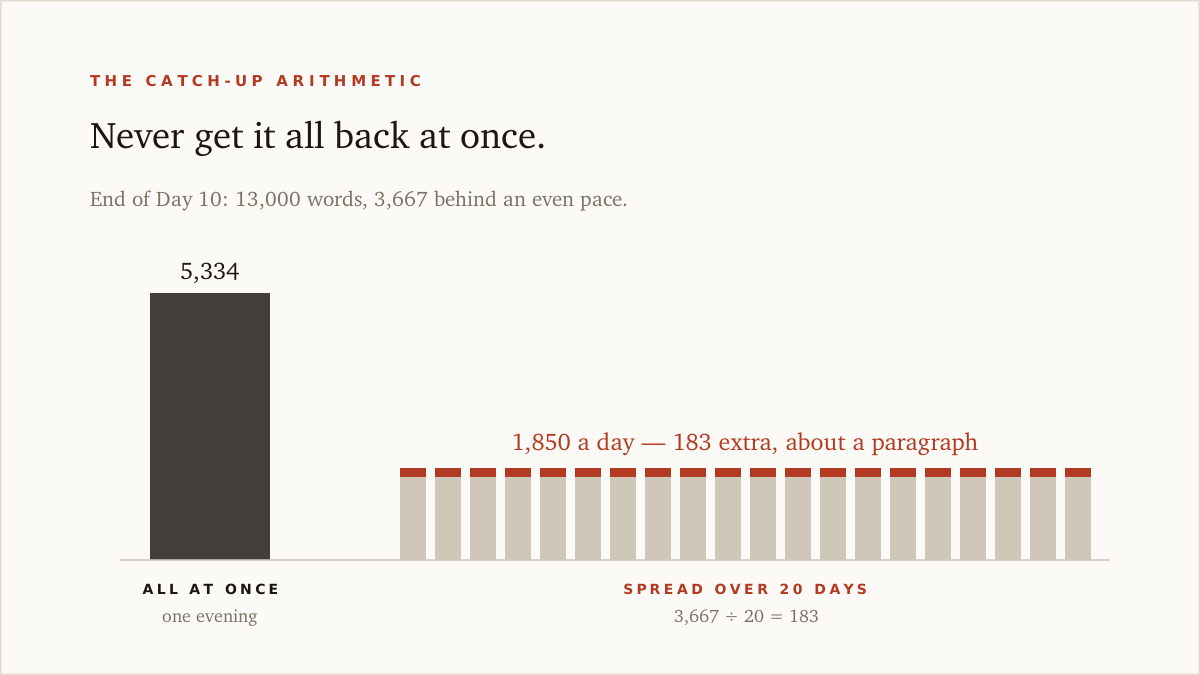
Say it is the end of Day 10 and you are at 13,000 words. An even pace would have you at 16,667, so you are 3,667 behind, with twenty days to go.
3,667 ÷ 20 = 183.
Your new daily target is not 5,334. It is 1,850 — 183 words more than before. That is about a paragraph. Most people can add a paragraph a day without noticing.
Here is the same sum for a few common situations at the end of Day 10:
| Behind by | Extra per day, over 20 days | New daily target |
|---|---|---|
| 1,000 | 50 | 1,717 |
| 3,000 | 150 | 1,817 |
| 5,000 | 250 | 1,917 |
| 8,000 | 400 | 2,067 |
Eight thousand words behind is five missed days. Recovered over twenty days, it is four hundred extra words an evening. That is hard, but possible. Five thousand words in one night is not.
If your week has longer days in it — a weekend, a day off — put more of the deficit there and less on work nights. Spread it however suits the week you actually have. The only rule is never all at once.
The floor
There is a second number worth knowing before November starts, and it matters more than the first: three hundred words, every day, no exceptions.
Three hundred words is fifteen minutes at a slow drafting speed. It is a short scene, a page of dialogue, a paragraph of summary and a note in square brackets. You can do it on the worst day of the month, on a phone, on a train, in bed.
Three hundred words will not save your total. That is not what it is for. It protects the streak — the plain fact that you have not stopped. Almost nobody abandons a month-long draft on a day they wrote. They abandon it on the second day in a row that they didn't. The floor makes sure there is never a first one.
If you have missed several days
When the gap is a day or two, it is a counting problem. When it is three days or more, it is a habit problem, and those need different repairs.
Missed one day: tonight, write your normal target — not double. Spread the missing day over the next three, at about 550 extra words each. You will be back on pace by the end of the week without a single hard evening.
Missed three days: tonight, write the floor and stop. The point is to break the gap, not to catch up; a small session that happens beats a large one that doesn't. Tomorrow, your normal target. The day after, do the arithmetic.
Missed five or more: the floor tonight, and the floor again tomorrow. Two small sessions in a row rebuild the habit faster than one big one. On the third day, reset the goal honestly.
When the numbers stop working
Sometimes the division gives you an answer your life does not contain. Fifteen thousand words on Day 20 means 3,500 a day for the rest of the month, and you know perfectly well you are not going to write 3,500 words on a Tuesday.
This is where most people quit — not because they have stopped wanting the book, but because failing at an impossible number every evening for ten days is miserable, and quitting ends the misery.
There is a better way to end it. Move the finish line, on purpose.
Your total tonight, plus the days left multiplied by what you write on an ordinary day — not your best, your ordinary — is your new target for Day 30. At 15,000 words with ten days left and an ordinary day of 1,200, that is 27,000. Write it on your tracker. Cross out fifty thousand. Aim at the new number with exactly the same seriousness.
Then do the half that turns a retreat into a plan: work out when the draft will actually be finished. Twenty-three thousand words more, at a thousand a day after November, is about three weeks. Put the date in your calendar.
Fifty thousand words was never the real goal. It was a stand-in — a concrete, hard number standing in for a draft that exists, and the habit of writing it. When the stand-in becomes impossible, keep the thing it stood for.
Writing a novel in a month is a stunt. Finishing a novel at all is the thing that matters. And most of the people who finish are the ones who kept going after a deadline went past.
The book this came from
Thirty Days of Writing
The book has the full pace tables for thirty and ninety days, a page for anyone joining late, and the missed-days card — so that whichever way the month goes wrong, there is a plan for tonight that does not start with an impossible evening.
Kindle · Paperback