Before November, Decide Which 50,000 Words You Are Writing
The most common way to win a month-long novel challenge and still not have a novel. One decision prevents it, and it takes one evening.
This is adapted from the first chapter of Thirty Days of Writing, a day-by-day companion for the novel-in-a-month challenge. Five short chapters for the week before you start, then one entry for each day of the month, each handing you the single tool that day usually calls for.
Here is a writer who won.
She started on Day 1, fell behind in the second week, caught up over a long weekend, and on the evening of Day 30 her word counter said 50,112. She took a screenshot. She was entitled to.
A few weeks later she opened the file to see what she had.
She had a heroine who had just arrived in the city where the story was meant to happen. She had four chapters of backstory, a long and rather good dinner party, and a villain who had been mentioned twice and never appeared. The central conflict of the book — the thing the novel was about — was scheduled to begin around the next chapter.
She had written fifty thousand words of a novel that needed a hundred and ten thousand. The month that carried her through the easy part ended just as the hard part was about to start.
This is the most common way to succeed at a month-long novel and still not have one. There are writers who have won five years running and never finished a book.
What fifty thousand words is
Start with the arithmetic, because it is friendlier than it looks.
Fifty thousand words in thirty days is 1,667 words a day. Most people draft somewhere between one and two thousand words an hour once they are warmed up and not stopping to fix things. For most people, then, the daily target is about an hour's work — a little less on a good day, ninety minutes on a slow one.
An hour a day for a month is not heroic. It is a commitment on the scale of a gym membership you actually use. Hold on to that, because the second week will try to persuade you otherwise.
What fifty thousand words isn't
Fifty thousand words is a respectable length for a novel. Plenty of classics come in under it, and whole genres live comfortably around it: many category romances, many cozy mysteries, most middle-grade books.
But most adult novels run longer — seventy thousand, ninety, past a hundred and twenty in epic fantasy. If your story is naturally one of those, fifty thousand words is not your novel. It is a portion of it.
That fact does not hurt you. What hurts is not knowing which portion you are writing.
Why you have to decide before Day 1
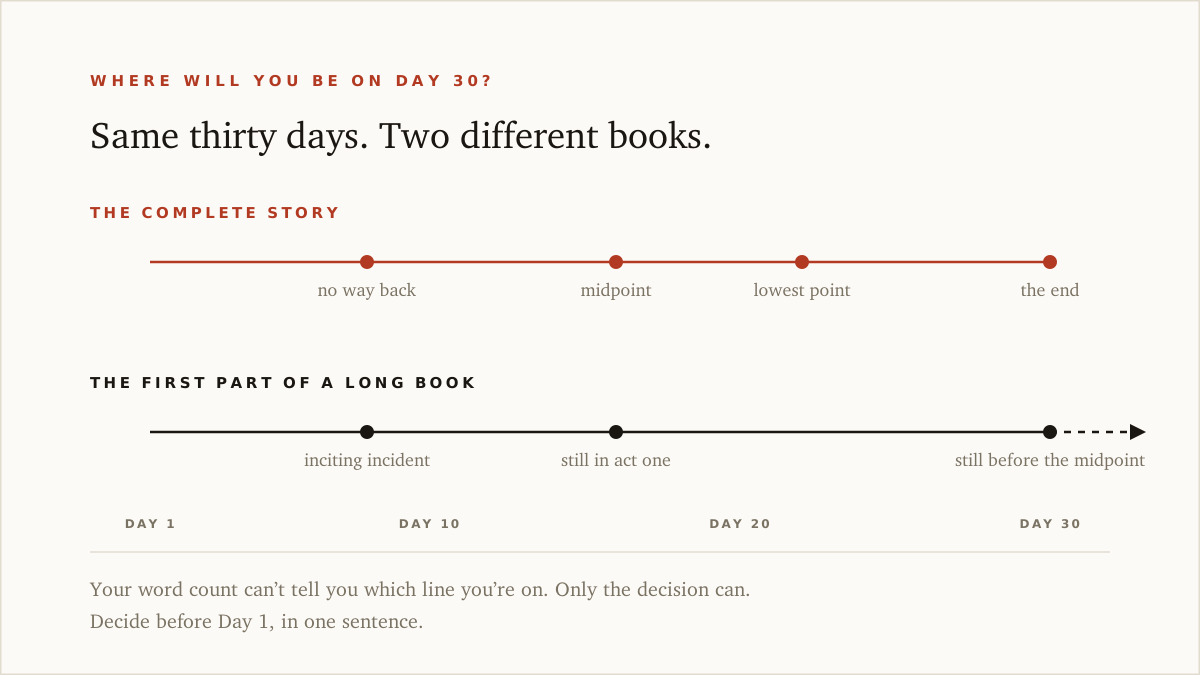
Picture the month as a line. Your word count climbs at roughly the same rate all the way along it. Your story has landmarks of its own: the moment the protagonist cannot turn back, the midpoint where something changes what the book is about, the lowest point, the climax, the end.
If you are writing a whole story in fifty thousand words, those landmarks fall at predictable places in the month. The point of no return comes around Day 8. The midpoint around Day 15 or 16. The lowest point around Day 22. The ending in the last week.
If you are writing the first fifty thousand words of a long book, almost none of them land inside November. Your Day 8 is the inciting incident. Your Day 16 is somewhere in the first act. Your Day 30 arrives before the midpoint.
Neither line is wrong. What goes wrong is not knowing which one you are on — writing Day 16 as though it were your midpoint when you are really a fifth of the way in, or spending the whole month on setup and discovering at the end that setup was the month.
Your word count cannot tell you which line you are on. Only the decision can. That is why you make it now, before the words start arriving and the number starts to feel like progress on its own.
The case for not deciding
The objection deserves a fair hearing.
Many writers do not know what their story is until they write it. They find the characters on the page, and the best twist turns up on Day 19 without having been planned. For them, fixing the shape of the book in advance feels like naming a baby before you know whether it is a baby.
That is true, and nothing here asks you to give up discovery. Your characters will surprise you, and when they do you should follow them.
But there is one decision discovery cannot make for you, because by the time discovery makes it, it is too late: where in your story you are aiming to be on Day 30.
The two paths
The complete story. You aim to reach THE END by fifty thousand words. Every major beat gets written, opening to climax, even if many scenes are thinner than they will eventually be. Some scenes will be a paragraph. Some will be a note in square brackets. The ending will be rough. But it will exist.
The first part. You are writing a long book and you use the month for its opening stretch, aiming at a real stopping point around fifty thousand words — the end of the first act, or the first major reversal. You know roughly how long the whole book will be, and you know November covers part of it.
Choose the complete story, especially if you have never finished a novel. A finished thin draft is worth more than two-thirds of a thick one, for three reasons:
- It teaches you the whole shape. You find out whether the ending works while the beginning is still cheap to change.
- It contains the hardest part. Middles and endings are where books die. This path makes you write them while you have the month's momentum and the company of everyone else doing it.
- Thin is fixable. Adding depth is a revision job, and a pleasant one. Writing an ending you never wrote, months later, when the book has gone cold, is the job most unfinished novels are still waiting for.
The first-part path is right when the book you want is long and you know it, when you have tried compressing a big story before and hated what it did, or when you are continuing a project that already has a plan beyond the month. If that is you, choose it without apology.
What you should not choose is neither.
The one-line test
Tonight, on a card or the first line of your manuscript file, write one of these two sentences and fill in the blanks.
I am writing the complete story of ______, beginning to end, in fifty thousand words.
>
I am writing the first part of ______, about ______ words long, and I will stop at ______.
One line. Put it somewhere you will see it in the middle of the month.
You are allowed to change your mind. Stories overrun, and occasionally they turn out smaller than you thought. Switching paths on purpose, halfway through, is a decision. Drifting is what happened to the writer at the top of this page. The difference is only whether you noticed.
The book this came from
Thirty Days of Writing
The book follows this decision through the whole month — when each story turn should fall on the path you chose, the checkpoint on Day 14 and Day 15 where you can switch on purpose, and what finishing means after Day 30 for each kind of draft.
Kindle · Paperback