If the second week is where it stops
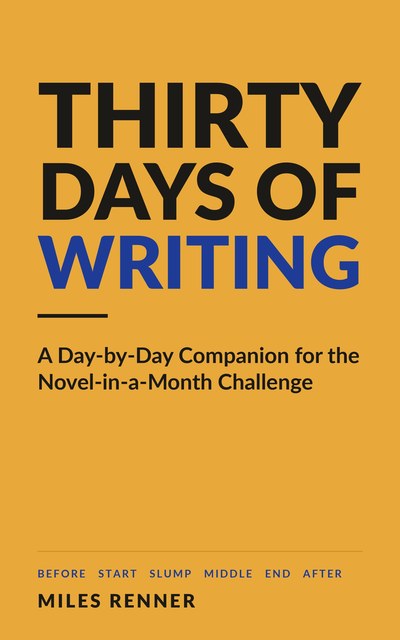
Thirty Days of Writing
A Day-by-Day Companion for the Novel-in-a-Month Challenge
Month-long novel drafts rarely fail for lack of talent. They stall in the second week.
Kindle · Paperback
The novelty is gone, the ending is still out of sight, and the plan for catching up asks for five thousand words in one evening. Most people who stop don’t stop because they can’t write. They stop because the month stopped making sense.
So this is not a pep talk delivered in advance. It is one short entry for each day, read before you write, each one handing you the single tool that day usually calls for — timed to the morning the problem actually shows up rather than the week you had the energy to read ahead.
Before Day One
Five short chapters for the week before you start, beginning with the choice most writers skip: which fifty thousand words you are actually writing. A complete story, thin but finished? Or the first part of a longer book? The answer changes every decision that follows, and almost nobody makes it on purpose.
Then the smallest map you can draft from, an hour that is genuinely yours, company if you are writing alone, and a kit for the mornings when nothing comes. Starting tomorrow? Day 0 does all of it in twenty minutes.
Thirty days, one tool at a time
- How to start in motion — and why you should stop in the middle of a sentence.
- The catch-up arithmetic that turns “I’m behind” from a crisis into a paragraph a day.
- Try-fail cycles, the midpoint turn and the lowest point, each on the day your story needs them.
- A 300-word floor that keeps the streak alive on the worst day of the month.
- What to do if you are far behind — and, separately, what to do if you are ahead.
- Weekly checkpoints, and a fifteen-minute reverse outline for discovery writers.
Every entry ends with Today’s Words: where an even pace puts you tonight, where your story should be, and one task you can finish in today’s session. A single running example — a novel about a woman fighting to keep her family’s lighthouse — shows each tool at work rather than describing it.
After Day Thirty
How long to let the draft rest, how to read your own numbers as a diagnosis, and how to finish the book — whichever kind of fifty thousand you wrote. The appendices carry pace tables for thirty and ninety days, a plan for missed days, a page for late starters, genre beats on one page, and a one-page tracker.
For November, or any thirty days you choose.
“A finished thin draft is worth more than two-thirds of a thick one.”
Contents
- •How to Use This Book
- •Writing with AI Instead?
PART ONE — Before Day One
- 1Which Fifty Thousand?
- 2An Idea and a Map
- 3Finding the Hour
- 4Company
- 5The Rules and the Bad-Day Kit
- •Day 0 — The Night Before
PART TWO — Week One: The Running Start
- •Day 1 — Start in Motion
- •Day 2 — The Scene Is the Unit
- •Day 3 — When the Novelty Wears Off
- •Day 4 — The Story Leaves the Map
- •Day 5 — Bank Something
- •Day 6 — You Hate Your Prose
- •Day 7 — Checkpoint One
PART THREE — Week Two: The Slump
- •Day 8 — No Way Back
- •Day 9 — The Wall
- •Day 10 — The Catch-Up Arithmetic
- •Day 11 — Middles Are Made of Failed Attempts
- •Day 12 — Skip to the Scene You Want
- •Day 13 — The Shiny New Idea
- •Day 14 — Checkpoint Two
PART FOUR — Week Three: The Long Middle
- •Day 15 — Halfway, by Which Measure?
- •Day 16 — The Turn
- •Day 17 — Talk It Out
- •Day 18 — The Subplot as Fuel
- •Day 19 — Aim at the Ending
- •Day 20 — If You’re Far Behind
- •Day 21 — Checkpoint Three
PART FIVE — Week Four: Toward the End
- •Day 22 — The Lowest Point
- •Day 23 — Bridges Count Now
- •Day 24 — If You’re Ahead
- •Day 25 — The Climax Is a Choice
- •Day 26 — Write the Ending Now
- •Day 27 — Counting Honestly
- •Day 28 — Checkpoint Four
- •Day 29 — The Last Full Day
- •Day 30 — Fifty Thousand, or Not
PART SIX — After Day Thirty
- 6Rest, Then Read the Numbers
- 7Finishing the Draft
- •Appendices A–H — pace tables, where the story falls, missed days, joining late, genre beats, the bad-day kit, the checkpoint form, the tracker
Who it's for
- You are doing a month-long novel challenge and you have stalled in week two before.
- You want a plan that survives a missed day rather than one that collapses on it.
- You would rather finish a thin complete draft than abandon a thick incomplete one.
Who it isn't for
- You want a book to read cover to cover before November. This one is read a day at a time, in the month itself.
- You are revising rather than drafting. That is The Rewrite.
Questions
How do you write a novel in 30 days?
By making the month legible rather than heroic: a pace you can actually hold, one decision per day, and arithmetic for the days you miss. The usual failure is not a shortage of talent but a plan with no slack in it — so the first missed day turns into a deficit no evening can clear, and the writer quits on the maths rather than the book.
What do I do when I fall behind on a novel-in-a-month challenge?
Recalculate instead of catching up. The catch-up arithmetic spreads the shortfall across the days you have left, which usually turns a terrifying number into an extra paragraph a day. Day 20 is devoted to being far behind, and there is a 300-word floor for the worst day of the month — small enough to be survivable, large enough to keep the draft alive.
Is 50,000 words a whole novel?
It can be a complete short novel, or the first part of a longer one — and which of those you are writing is the choice Chapter One makes you make before Day One. Deciding it in advance changes your outline, your pacing and what “done” means on Day 30.
Do I have to do this in November?
No. The book is built for any thirty days you choose; November is just the month most people pick. The pace tables cover thirty and ninety days, and there is an appendix for joining late.
Does it work for discovery writers who don’t outline?
Yes. The map in Chapter Two is deliberately the smallest one you can draft from, not a full outline, and there is a fifteen-minute reverse outline for writers who would rather find the shape on the way.
How is this different from The Four-Day Novel?
Different problem. The Four-Day Novel is a method for drafting with AI tools. This is a companion for writing fifty thousand words yourself over a month — pacing, morale and the specific place each week tends to break.
Thirty Days of Writing
One short entry for each day of your month, read before you write. Each takes under three minutes and hands you the one tool that day usually calls for, timed to when the problem actually shows up.
Kindle · Paperback
Also by Miles Renner