Novel-Writing Challenges for November 2026
Where to write your 50,000 words. The organisation behind the original month-long challenge closed in 2025; the month did not. What is running this November, how the options differ, and how to pick one.
Whichever program you join, Thirty Days of Writing works alongside it — one short entry for each day of the month, read before you write, each handing you the single tool that day usually calls for. Pace tables cover thirty and ninety days, so it fits a 90-day program too.
For a quarter of a century, writing a novel in November meant one thing. The challenge began in 1999 with twenty-one people in San Francisco and grew into a fixture of the writing year; by the middle of the 2010s, hundreds of thousands of people were signing up every autumn.
On 31 March 2025, the nonprofit behind it, NaNoWriMo, announced it was closing, citing financial trouble after several difficult years.
The organisation went. The month stayed. Fifty thousand words in thirty days was never really a product anyone owned — it is an idea, and a good one — and a number of groups have picked it up. If you are planning to write a novel this November, you have more choice than you did when there was one obvious place to sign up.
Here is what is running, what each one asks of you, and how to tell which suits the way you work.
What is running in November 2026
Details below are from each program's own pages as of mid-October 2026. Rules change, so check the official page before you commit.
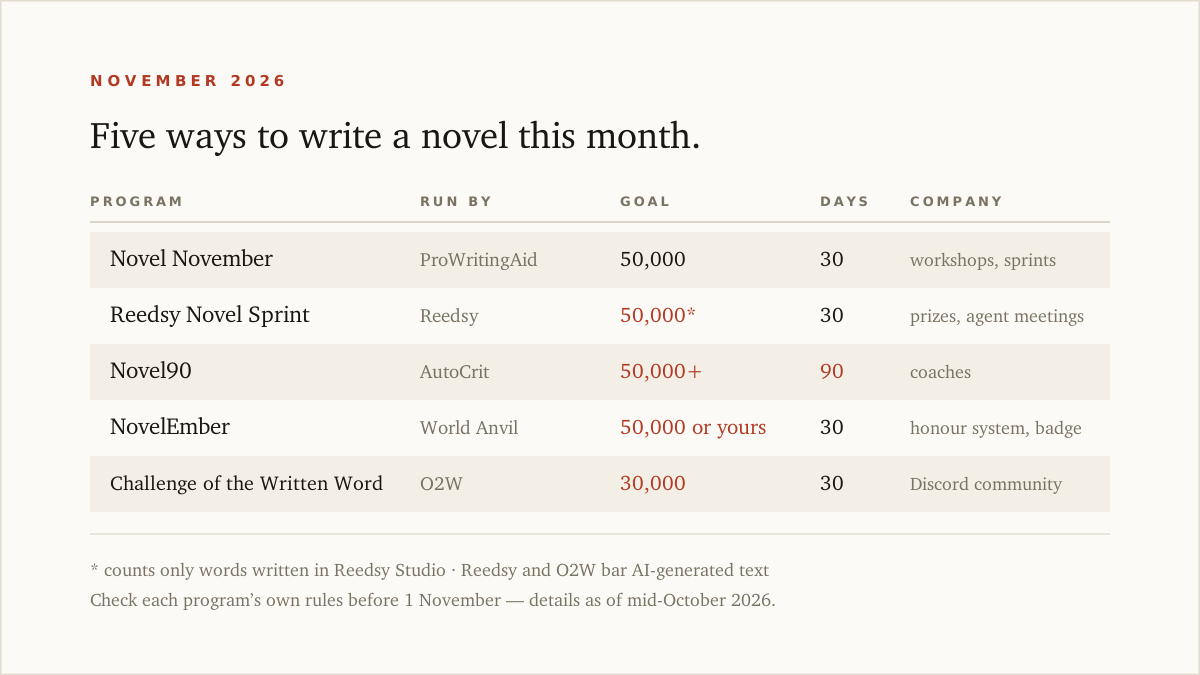
Novel November, run by ProWritingAid. The closest thing to the old format: 50,000 words between 1 and 30 November, about 1,667 a day, with an October prep phase that has already begun. It is free, though you need a free ProWritingAid account. You can track words written in Word, Scrivener or Google Docs, or log them by hand. Alongside the count there are daily writing sprints, forums, and a programme of more than 150 live workshops.
Reedsy Novel Sprint, run by Reedsy. Also 50,000 words in November, but with two differences that matter. You must write inside Reedsy Studio, the company's free browser-based editor — the page is explicit that you cannot paste in text from elsewhere — and there are prizes: $5,000, $2,500 and $1,000 for the top three, each with a thirty-minute meeting with a literary agent. Using AI to generate the book gets you disqualified. You can bring an existing project, provided you add 50,000 new words to it.
Novel90, run by AutoCrit. The slow version: 50,000 words or more over ninety days, which works out at roughly 550 words a day instead of 1,667. It is free, and comes with team coaches for planners, discovery writers and the people in between. The fall edition began on 1 October, so check whether registration is still open if this is the one you want.
NovelEmber, run by World Anvil. A November challenge with a standard 50,000-word prose goal — or, if you would rather, a goal you set yourself, including worldbuilding. It runs on an honour system and ends in a digital badge and a printable certificate. It has run every November since 2024; look for the 2026 page before you start.
The Challenge of the Written Word, run by the Order of the Written Word (O2W). Free, run through a Discord server, with three tracks: 30,000 words of a novel, fifteen poems or eight short stories, or a revision of something you have already drafted. The organisers describe it as a celebration of human-driven storytelling, free of AI-generated content.
How the options actually differ
On the surface they look alike: a goal, a month, a tracker, some company. The differences that matter are underneath.
The number. Fifty thousand is the classic target, and three of the five keep it. O2W's novel track asks for 30,000. Novel90 asks for the full 50,000 but gives you three times as long. NovelEmber lets you pick. If you have a job, children, or a November that is already full, the number is the first thing to get right — a target you will abandon on Day 11 is worse than a smaller one you will hit.
Where you have to write. Most of these let you write wherever you already write. Reedsy does not: the sprint only counts words typed into its own editor. That is no obstacle if you have no strong attachment to your current tools, and a real one if you do your best work in Scrivener with forty open notes.
What kind of company. This is the most personal choice and the one people think about least. ProWritingAid offers a large, structured programme with workshops. AutoCrit offers coaching. O2W is a Discord community, which some people love and others find exhausting. World Anvil is mostly you and a badge. Reedsy adds competition and prize money, which motivates some writers and quietly ruins the month for others.
The AI rule. Reedsy and O2W both rule out AI-generated text explicitly. If you use any AI tools in your process — even just to tidy notes — read the rules of whichever program you choose before 1 November, not after.
Who runs it. Four of the five are run by companies that make writing software, and the programs are, in part, a way to introduce you to it. That is not a reason to avoid them: they are free, and several are generous. It is just worth knowing whose house you are in, especially if a program requires you to write inside its own tool.
How to choose in five minutes
Answer three questions honestly.
- How many words can you write on an ordinary day — not your best one? If it is under a thousand, look at Novel90 or set your own goal. If it is over fifteen hundred, any of them will work.
- Do you want to be watched, or left alone? If you want structure and people, Novel November or AutoCrit. If you want a community but a smaller one, O2W. If you want to be left alone with a target, NovelEmber or your own.
- Does a prize help you or hurt you? If competition makes you work, Reedsy. If it makes you check your rank instead of writing, choose something without one.
There is a fourth option that is easy to forget: none of them. The month does not belong to anyone. A calendar, a target, a tracker on the back of an envelope and one friend doing it alongside you is a perfectly good challenge, and some people find it calmer than any of the above.
What none of them gives you
All five programs supply the same three things: a target, a way to count, and a sense that other people are doing it too. Those are real and they help.
What they cannot supply is the specific thing that goes wrong on a specific day. The second week, when the novelty is gone and the end is out of sight. The evening you fall behind and the catch-up plan starts asking for five thousand words. The morning you read back Tuesday's chapter and hate every sentence in it. The new idea that arrives around Day 13 and is so much better than the one you are writing.
Those problems arrive on roughly the same days for nearly everyone, whichever program they joined. That is worth knowing before you start, because the point where most month-long novels stop is not the first week. It is the second.
Choose your program by the end of October. Then get ready for Week Two.
The book this came from
Thirty Days of Writing
Every program on this list gives you a target, a tracker and company. None of them tells you what to do on Day 9, when the novelty is gone and the ending is still out of sight. That is the job Thirty Days of Writing was built for — a day-by-day companion you can use with any of them, or with none.
Kindle · Paperback