What Is Upmarket Fiction?
Every definition says the same thing — literary quality, commercial appeal. None of them tells you what to do. Here is the mechanism underneath the mood.
This is the opening argument of How to Write Upmarket Fiction, the short guide to the novel that is both literary and commercial. Eight chapters, each ending with a test you run on your own manuscript, and all eight collected into a one-page audit at the back.
An agent's wish list says upmarket women's fiction. A contest category says upmarket suspense. A workshop leader tells you your novel is "almost upmarket, it just needs to be more upmarket."
So you look the word up. And every definition you find says the same thing, in the same words: literary quality, commercial appeal. Fiction that sits between literary and commercial. Beautiful writing, but with a story.
You nod. You close the tab. And you still cannot tell whether your book is one.
That is not a failure of attention. It is a failure of the definition.
The problem with "literary quality, commercial appeal"
It describes an outcome, not a method.
Say that definition out loud and ask yourself what to do on Monday morning. Make the prose more beautiful? More accessible? Both, somehow, at once? The definition tells you how the finished book is supposed to feel to someone who has already read it. It gives you nothing to revise towards.
Worse, it points most writers at the wrong drawer. Told that upmarket means literary quality, a writer goes and works on sentences. The prose gets genuinely better. The manuscript does not get any closer to the thing agents are asking for, because the part that was missing was never at sentence level.
A definition you cannot revise towards is not a definition. It is a mood.
The mechanism
Here is the version that survives contact with a draft.
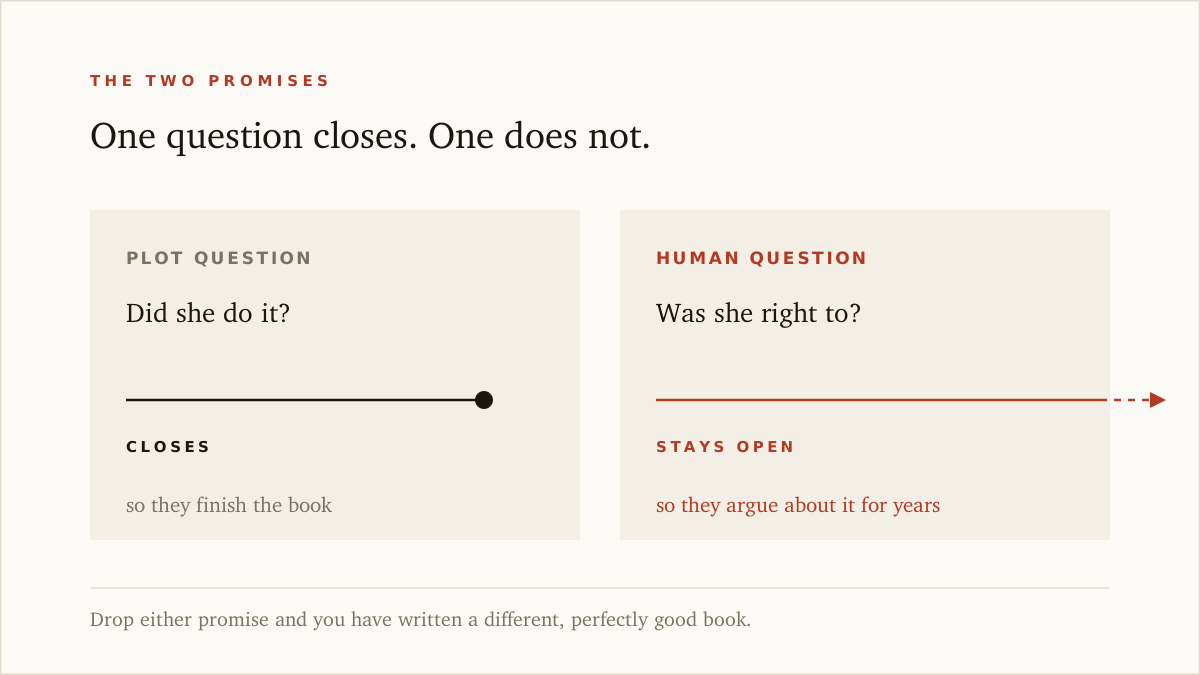
An upmarket novel makes two promises at once. It answers a plot question that keeps the pages turning, and it leaves a human question open that readers will argue about for years.
Two questions. One of them closes. One of them does not.
People finish upmarket books because the first question closes. Did she do it. Does he come back. What was in the letter. Something was asked in chapter one and answered by the end, and the pull between those two points is what gets a reader through four hundred pages on a Tuesday night.
People talk about upmarket books because the second question doesn't close. Was she right to do it. Would I have forgiven him. Is that a marriage or a hostage situation. The book declines to rule. Two readers finish it with opposite verdicts and both can point at the text.
That second question is where the recommendations come from. It is why these books end up in book clubs, why they stay on backlist for years, why one reader presses a copy on another. A novel that settles everything is finished the moment it is finished. A novel that leaves one thing genuinely unsettled keeps working in the reader's head, and the reader keeps working for the book.
Why it has to be both
Drop either promise and you get a perfectly respectable book that is not this one.
Close both questions and you have written commercial fiction. The plot resolves, the moral resolves, the reader is satisfied and does not think about it again. Nothing is wrong with that — it is most of what sells — but nobody is going to argue about it at a book club, and an agent looking for upmarket will pass.
Close neither and you have written something closer to literary fiction. The human question stays beautifully open. No plot question was ever asked, so there is nothing pulling the reader forward except the quality of the attention, which works for a certain reader and loses most of the others around page sixty.
Upmarket is the narrow thing that does both jobs in the same book. Not a compromise between them — a book that takes on two obligations instead of one.
How to test your own manuscript
Two sentences. Write them out properly; do not do this in your head, because in your head everything sounds fine.
One. The question this book answers is ———. It should be answerable, it should be answered on the page, and a reader should be able to tell you roughly when it was answered.
Two. The question this book refuses to answer is ———. It should be a question about people rather than plot. It should be one that two reasonable readers could answer differently. And — this is the part that catches most drafts — your book should have given both answers a real case.
Now look at what you wrote.
If you could not write the first sentence, your book may be lovely and it is probably slow. There is nothing for the reader to lean towards.
If you could not write the second, or if you wrote it and realised your novel actually does answer it, somewhere near the end, in a scene where a character explains what everything meant — that is the common one. The draft had an open question and then closed it, usually out of a fear of leaving the reader unsatisfied.
If the two sentences are the same sentence, you have one question doing both jobs, and it will end up doing neither.
Three things upmarket is not
It is not a genre. It describes how a novel is built, not what it is about. You can write upmarket suspense, upmarket historical, upmarket speculative, upmarket family drama. The departments on the shelf are unchanged; the construction is what the word refers to.
It is not women's fiction. The two get bolted together so often — upmarket women's fiction is a real and frequently used phrase — that writers assume the first word implies the second. It doesn't. Women's fiction is a category about subject and readership. Upmarket is about the two questions.
It is not literary fiction with a wider audience. That framing is what sends writers back to their sentences. The difference is not that an upmarket novel is easier; it is that an upmarket novel took on an obligation literary fiction is allowed to decline — to ask a question and then actually answer it.
What about examples?
Ask a bookseller for upmarket fiction and you will get a shelf of novels with very little in common on the surface — a murder in a marsh, a fire in an Ohio suburb, a travelling theatre company after a pandemic, a family running a hotel across decades. Different genres, different registers, different decades.
Run the two-question test on any of them and the shape appears immediately. There is something you want to know, and you keep reading to find out. And there is something the book declines to settle — whether a particular person deserved what happened, whether a mother was right, what we owe the people we left behind — which is why two readers can finish the same novel and disagree about it for an hour.
This is why a list of comps is a weaker guide than it looks. The books on it do not resemble each other; they are built the same way. If you are choosing comps for a query letter, pick the ones whose open question is nearest to yours, not the ones with the nearest setting.
Where this leaves you
If you have been told your book is almost upmarket, the useful next move is not to make the prose more beautiful or the plot more exciting. It is to find out which of the two promises your manuscript is not making, because the repairs point in opposite directions and doing the wrong one costs a draft.
That is a diagnosis, and it takes an afternoon rather than a rewrite.
The book this came from
How to Write Upmarket Fiction
The guide takes this definition and does the work with it — the two opposite ways manuscripts land "almost upmarket", building a plot engine without sliding into formula, the lyricism budget, and how the category behaves inside suspense, historical, women's fiction and speculative.
Kindle