The Tidy Ending — How a Satisfying Twist Can Kill Your Book
The last forty pages work beautifully. Everything comes together. And the thing people were going to argue about quietly disappears.
The tidy ending is one of eight chapters in How to Write Upmarket Fiction, the short guide to the novel that is both literary and commercial. A test at the end of every chapter, and all eight collected into a one-page audit at the back.
Here is a revision that feels like a triumph and is often a loss.
A writer has a novel about a woman who did something indefensible — abandoned a child, testified against a brother, took money she knew where it came from. Four hundred pages are spent in her company. Readers find her maddening and cannot look away.
Then, in revision, the ending gets better. A last chapter reveals what she knew that nobody else did. A letter turns up. A scene from twenty years earlier explains the thing she could never say.
It lands. Early readers write back saying they cried, that it all came together, that they did not see it coming.
And the book club conversation that was going to run for an hour is now four minutes long, because there is nothing left to disagree about.
What the ending just did
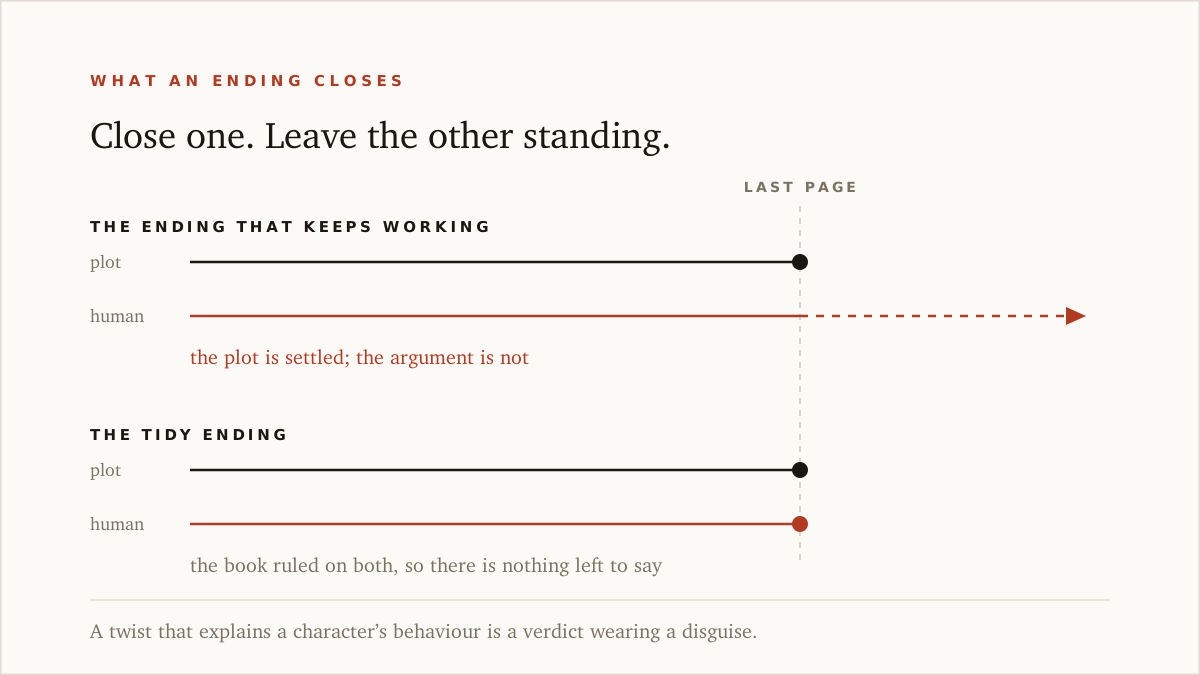
The revelation did not only answer the plot question. It answered the human one.
Before the last chapter, two readers could finish this novel and split. One says she was monstrous. The other says she was cornered, and that most of us overestimate what we would have done. Both can point at scenes. Neither can prove the other wrong, which is exactly why they will keep talking.
After the last chapter, there is a fact. She knew the thing. Given the thing, her choice was defensible. The argument is over — not because the reader was persuaded, but because the book produced evidence and ruled.
A twist that explains a character's behaviour is a verdict wearing a disguise.
Why writers do it, and why it is hard to see
Because it is generous, and because it is frightening to be disliked.
You have lived with this person for two years. You know why she did it. Watching readers judge her with a fraction of the information is genuinely uncomfortable, and a final revelation is the obvious way to even things up — to say, at last, here is what she was carrying.
It is also the ending that gets the best immediate reaction, which is the trap. Beta readers reward resolution. They tell you it came together. What they cannot report is the conversation that will not now happen, because that conversation is a counterfactual and nobody writes to you about one.
And the mechanics are invisible from the inside, because the twist is usually true. You did not invent an excuse; you revealed a fact that was there all along. The problem is not honesty. It is that the fact settles an argument the book existed to hold open.
A test for your own last chapter
Write down, in one sentence, the question your novel refuses to answer. About people, not plot. The one you want two readers to disagree about.
Now read your final chapter and ask: after this, can a reasonable reader still take either side?
Three outcomes.
They can. The ending closed the plot question and left the argument standing. This is the one you want.
They cannot, and the last chapter is why. You have a tidy ending. Something late in the book supplied the deciding fact.
They never could. The open question was not actually open — one side had a straw man from the start. That is a different problem, and it lives in the middle of the book, not the end.
What to do if you have one
The repair is almost never to delete the revelation. It is usually to move it, or to cost it.
Move it earlier. A fact that arrives in chapter nine is information the reader weighs for the rest of the book. The same fact in the final chapter is a ruling. Writers are often protecting a surprise that the novel does not actually need, and the book gets stronger when the reader has to live with the knowledge rather than receiving it as absolution.
Give it a price. The revelation can explain the choice without excusing it. She knew the thing — and she still did not tell the one person who deserved to know, and that person is at the funeral in the last scene. Now the reader has more information and the same argument, which is the point.
Let someone good disagree with the ending. Not a villain. A character the reader respects, who hears the whole story and still thinks she was wrong, and is given a real sentence to say it in. One honest objection in the last ten pages can hold a question open against a great deal of resolution.
The underlying rule
An ending has two jobs and they are not the same job.
It has to close the plot question, firmly, because that is what the reader was promised and withholding it is just a different kind of bad faith. And it has to leave the human question standing, because that is the part that outlives the reading.
Most weak endings fail by closing neither. The tidy ending fails by closing both — which is the more painful failure, because from the inside it feels like the book finally working.
The book this came from
How to Write Upmarket Fiction
The guide works through what an ending has to close and what it has to leave alone, alongside the plot engine that gets a reader there and the lyricism budget that decides where the book slows down.
Kindle