Your Prose Is Beautiful and Your Story Is Slow
Everyone praises the writing. Nobody can put the book down and nobody can pick it up either. The problem is almost never the sentences — it is where you spent them.
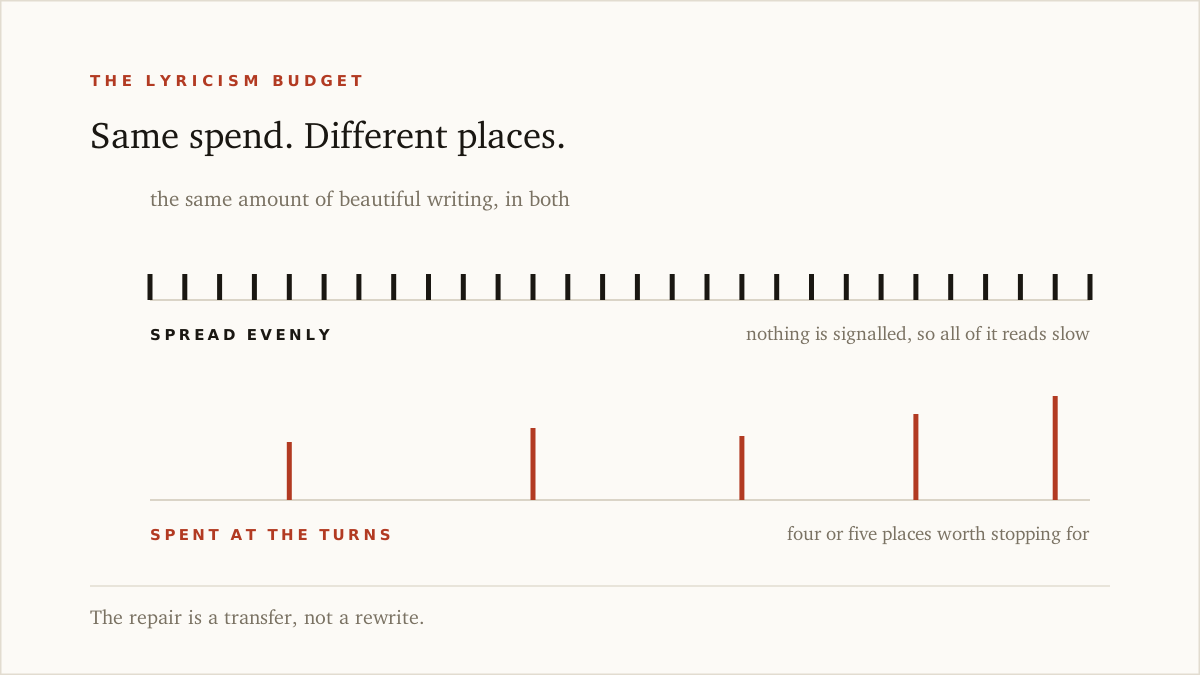
The lyricism budget is one of eight chapters in How to Write Upmarket Fiction, the short guide to the novel that is both literary and commercial. Each chapter ends with a test you run on your own manuscript; all eight are collected on one page at the back.
The feedback arrives in a particular shape. The writing is gorgeous. A pause. I did find it a little slow in the middle.
You have heard it from a workshop, a beta reader, two agents and your sister. It is always said kindly, and it is useless, because the two halves of it point in opposite directions and nobody tells you which one to act on.
So you do the thing anyone would do. You go back to the sentences — the part of the job you are good at, the part with a visible edge — and you make them better. They do get better. The note comes back unchanged.
Here is why.
Good prose does not create momentum. It spends it.
A beautiful paragraph asks the reader to slow down and look. That is what it is for. The precise verb, the image that lands, the rhythm that makes someone read a line twice — all of it works by holding attention in place for a moment instead of moving it forward.
Which is a cost. A small one, paid gladly, when the thing being looked at is worth the stop.
The trouble is that a writer who can produce that paragraph can usually produce it anywhere. On the drive to the hospital. On the third description of the kitchen. On a minor character crossing a room. And a novel in which every paragraph asks the reader to stop and look is a novel in which nothing is ever signalled as worth stopping for — so the reader stops at all of it, which feels, from the inside, like being unable to get going.
The prose was never the problem. The distribution was.
The lyricism budget
Treat beautiful writing as a limited resource. Not because you cannot produce more — you can — but because its effect depends on scarcity, and spending it evenly destroys the thing you were spending it on.
So the question stops being is this paragraph good and becomes is this one of the places in the book where I want the reader to slow down.
A novel has a small number of those. The moment a character understands something they cannot un-understand. The scene the whole book has been walking towards. The last page. The image you want someone to still have in their head three months later. Four or five such places in a full-length novel; rarely more than seven.
Those are where the budget goes. Everywhere else, the prose has a different job, which is to be clear and get out of the way.
How to audit it in an afternoon
Print the manuscript, or scroll it, and mark every passage where you were consciously writing well — where you reached for the better image, lengthened the rhythm, let a paragraph breathe. You will know them. They are the bits you reread with a slight glow.
Now mark, separately, the four or five places where the book turns.
Lay the two maps over each other.
Almost every "lovely but slow" manuscript shows the same thing: the marks are spread evenly, and the turns are not marked at all. The writing is at its most careful in the quiet passages, and at its most ordinary in the scenes that carry the weight — because by the time you reached those scenes you were writing hard and fast, inside the story, not thinking about the prose.
The repair is a transfer, not a rewrite. Flatten some of the decorated quiet. Spend what you take back on the turns.
Two objections worth answering
"Isn't this just telling me to write worse?"
No — it is telling you to write plainly where plainness is the right instrument. A sentence that moves a character through a door quickly and invisibly is doing a job well. Treating every sentence as a showcase is not a higher standard; it is a refusal to make choices, and the reader experiences the refusal as fog.
"My book is literary. The texture is the point."
Then the budget applies differently, and that is a real position — a literary novel can legitimately run a high, even rate of attention throughout, because it has made a different deal with its reader. But if you are getting the "lovely but slow" note from people who were expecting a story, the book is probably making a promise it has not decided to keep. That is a question about what you are writing, not about your sentences.
The other half of the diagnosis
The budget explains why a good book reads slowly. It does not, by itself, explain why nothing is pulling.
If a reader has nothing they want to know — no question the book asked clearly enough to carry them over a dull patch — then no redistribution of beautiful writing will fix it, because there is no momentum to redistribute. That is a structural problem and it has a separate repair.
Which is why "lovely but slow" is two notes wearing one coat, and the first job is to work out which one you have been handed.
The book this came from
How to Write Upmarket Fiction
If "lovely but slow" is the note you keep getting, the budget is one half of the diagnosis and the plot engine is the other. The guide covers both, plus the ending that quietly kills the question your book was about.
Kindle