Upmarket, Literary or Commercial — Which One Is Your Novel?
Three categories, one grid, and a test that takes ten minutes. Most manuscripts are not where their author thinks they are.
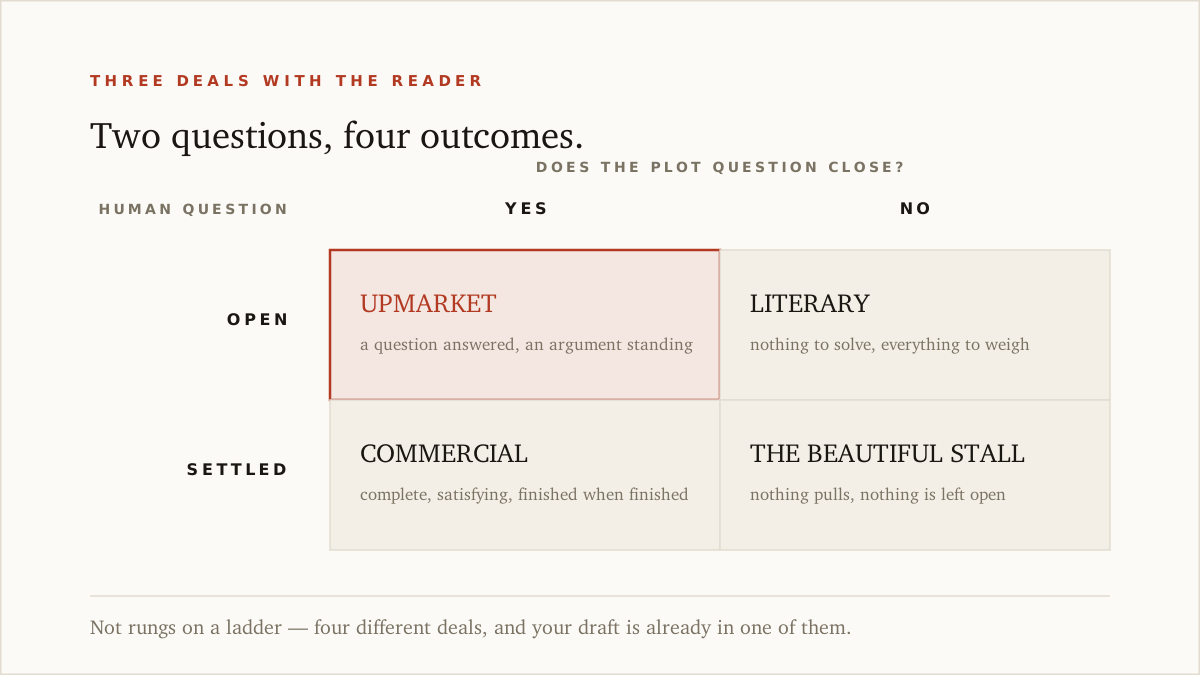
This grid is the spine of How to Write Upmarket Fiction, the short guide to the novel that is both literary and commercial. Eight chapters, a test at the end of each, and a one-page audit at the back you can run against any draft.
Writers are told these three words as though they were rungs on a ladder. Commercial at the bottom, literary at the top, upmarket somewhere in between for people who want both.
That picture is wrong, and it is expensive. It turns a question about construction into a question about status, which means a writer trying to "move up" starts polishing sentences, and a writer trying to "broaden" starts adding car chases, and neither of them has touched the thing the categories actually describe.
They are not quality levels. They are three different deals with the reader, and the deal is decided by two questions.
The two questions
Every novel asks a plot question — the thing a reader wants to know. Who took the child. Will the restaurant survive the winter. What is in the letter she never opened. It can be loud or quiet. What matters is whether the book answers it.
Every novel also raises a human question — the argument underneath. Was she right to leave. Can you forgive someone who is not sorry. Does a good reason make a bad thing all right. Again, what matters is whether the book settles it.
Two questions, two possible fates each. That is a grid with four cells, and three of them have names.
Commercial: both questions close
The plot question is answered, and so is the human one. The killer is caught and the book is clear that catching him was right. The couple get together and the book is clear that they belong together.
This is not a lesser achievement — it is the hardest kind of book to do well, and it is most of what people actually read. The deal is clean: give me your evenings and I will give you a complete experience with no loose ends.
What it does not generate is argument. A commercial novel that worked is finished when you close it. The reader is satisfied, which is exactly what was promised.
Literary: the plot question is optional, the human question stays open
Literary fiction is under no obligation to ask a plot question at all, and a great deal of it deliberately doesn't. The deal is different: follow this mind very closely, and in return I will show you something you had not seen.
What stays open is the human question. The novel sets up a genuine moral or emotional problem, gives it the best case on both sides, and then declines to rule — because ruling would be a lie about how the problem actually works.
That is a real deal, honestly kept, and it has readers. It also loses the reader who needs something to pull against, which is why "nothing happens" is the most common complaint about a literary novel from someone who was never its reader.
Upmarket: the plot question closes, the human question stays open
Both obligations, in the same book.
Something was asked in chapter one and gets answered. And something else — the argument underneath — is left genuinely unsettled, with both sides given a real case, so that two readers finish and disagree.
That combination is the whole category. The closed question is why the book gets finished by somebody who bought it in an airport. The open one is why that person makes somebody else read it.
The fourth cell has no name, and most "almost upmarket" drafts live in it
The plot question never closes — often because it was never clearly asked — and the human question gets settled anyway, usually in a late scene where somebody explains what it all meant.
Call it the beautiful stall. It is the cell manuscripts land in when a writer has been told to aim for literary quality and commercial appeal and has pursued both as atmosphere rather than as structure. The prose is frequently excellent. Nothing pulls, and nothing is left to argue about.
The useful thing about naming the cell is that it tells you the draft needs two different repairs, not one, and they have nothing to do with each other.
Running the test on your own book
Ten minutes, on paper, in these words:
- What does this book ask? Write it as a question with a question mark. If you cannot, or if it takes three sentences, your plot question is not doing any work.
- Where is it answered? Name the chapter. If the answer is "gradually", it is not closing.
- What does this book refuse to settle? Also as a question, also about people rather than events.
- Who in the book makes the opposite case, and are they any good at it? This is the one that catches drafts. An open question with a straw man on one side is not open; it is a verdict in costume.
The four answers put you in a cell. The cell tells you what you are writing — which matters most when it turns out not to be the thing you have been pitching.
Why the label matters at all
It is tempting to say all this is marketing noise and the book is the book. But the label is a promise made to a reader before they open it, and a broken promise does more damage than a modest one.
Pitch a quiet interior novel as upmarket suspense and the readers who arrive will be the wrong readers, who will leave the reviews that tell the next reader not to bother. Pitch a book with a real plot engine as literary and it will be read by people who did not want an engine, and ignored by the much larger group who did.
Getting the category right is not about aiming higher. It is about telling the truth early enough that the right reader finds you.
The book this came from
How to Write Upmarket Fiction
The guide goes further than the grid: the two opposite repairs for an "almost upmarket" manuscript, how the category behaves inside suspense, historical, women's fiction and speculative, why romance is a special case, and what changes when you publish the book yourself.
Kindle