Week Two Is Where Novels Stop — and What Is Actually Happening
Not a lack of willpower and not a bad idea. The second-week wall is made of three separate things, it arrives on schedule, and each part has its own fix.
This is adapted from Thirty Days of Writing, a day-by-day companion for the novel-in-a-month challenge. Week Two has an entry for every day of it, read before you write: the first big turn, the wall, the catch-up arithmetic, why middles are made of failure, skipping ahead, and the new idea that turns up uninvited.
Everyone who has done a month-long novel before will tell you the same thing: the second week is where it gets hard.
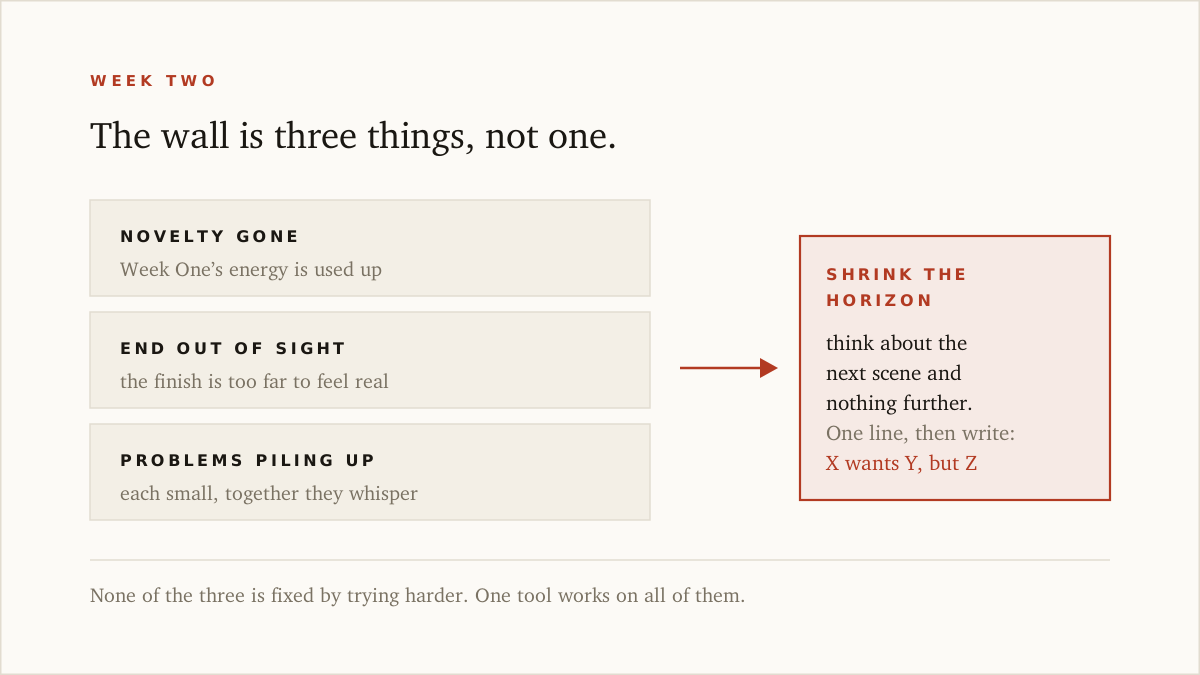
Nothing dramatic goes wrong. That is what makes it so effective. Three things simply happen at once. The novelty that carried you through Week One runs out. The ending is nowhere in sight. And the small problems you have been stepping around — the character who does not quite work, the plot point you have not figured out — start to pile up.
This is the week most people who stop, stop.
It helps enormously to know that in advance. The slump is not a sign your idea was bad, that you are not a writer, or that the month was a mistake. It is the middle of a long effort, and the middle of every long effort feels like this. Marathon runners have a mile for it. Writers have a week.
The wall is not one thing
It does not look like writer's block. You can still write. It is just that every sentence comes out of thick mud. You sit down at the usual time and something in you does not want to start, and when you do, the scene feels pointless.
Take it apart, because it is three things wearing one coat, and each has a different repair.
The novelty is gone. Week One ran on the pleasure of something new. That pleasure is used up and it will not come back until you can see the ending. This is completely normal. It happens on every long project anybody has ever done.
The end is out of sight. Nine days in, you have done less than a third of the month and the finish line is too far away to feel real. Any effort feels hopeless measured against a distance you cannot see the end of.
The problems are piling up. Your notes to yourself are multiplying. A character is not working. You are not sure the middle holds together. Each problem is small. Together they whisper that the whole draft is broken.
None of the three is fixed by trying harder.
Shrink the horizon
This is the main tool, and it works on all three parts at once.
For the next few days, do not think about fifty thousand words. Do not think about the month. Think about the next scene, and nothing further.
Not the shape of the story, not the ending, not whether the book is any good. Just: what is the next scene, who wants what in it, and what goes wrong? Write that as one line — X wants Y, but Z — and then write the scene. When it is done, write the next line.
A single scene is small enough to feel new. It is close enough to see the end of. And a single scene does not have forty problems. It has one or two, which you can handle or put in brackets for later.
The finish line has not moved. You have just stopped staring at it. Distance runners know the trick: in the hard middle miles you do not run the race, you run to the next lamp post.
Stop rereading
The wall has a favourite trap, and it sounds sensible: if I just read back over what I have written, I will get my bearings.
You will not. You will find twelve thousand words of first draft, which will look exactly like twelve thousand words of first draft, and the voice that says it is all broken will now have evidence.
So the rule for the rest of the month is: read only the last paragraph you wrote. Enough to pick up the thread. No more.
The shiny new idea
Somewhere around Day 13, it arrives. You are in the shower or on the bus, and suddenly there is another novel in your head — a completely different one, and it is wonderful. The premise is fresh, the characters are vivid, and a voice says: maybe this is the one I should be writing.
The timing tells you what it is. Your current book is now real: it has problems, contradictions, and a middle you have not solved. The new book is not real. It is pure possibility, every scene perfect because none of them is written. You are comparing a draft with a daydream, and the daydream will win every time.
The idea may well be good. The problem is not the idea; it is the timing. So give it fifteen minutes and a date.
- Write it all down — premise, characters, the scenes you can see, the first line, the feeling. Fifteen minutes. Not more.
- Give it a date after November, after you have rested from this draft, and put that date in your calendar.
- Close the file and go back to your book.
The date matters as much as the notes. Your mind keeps returning to an idea because it is afraid of losing it. Written down, it is safe. Dated, it has a future. Both together let you stop thinking about it.
People who give in to the new idea mid-month end up with a drawer full of promising twelve-thousand-word openings and no finished books.
When it is the middle itself
Sometimes the slump is not about you at all. It is about the book: the middle genuinely has gone inert, and you are the first reader to notice.
That is worth taking seriously, because your boredom is data. You are the first reader and you have the best seat in the house. If a scene bores you to write, it will bore someone to read. Treat the boredom as a location marker — something around here is inert — rather than a verdict on the whole project.
Middles usually go dead for one of a small number of reasons: events that happen without changing anything; the same beat repeated in three different costumes; a protagonist who keeps trying and succeeding, when middles run on trying and failing. And, most honestly of all, the writer simply wanting to be done.
Those four causes, and the repair for each, are a chapter of You Are Not Lazy.
The bluntest repair solves more middles than any technique: leave out the boring parts. You do not have to write the drive to the airport. You can skip to the scene you want to write, put a note in square brackets where the gap is, and fill it in December.
Get to Day 15
The second week ends. It always does. By the third week, many people find the story has turned a corner they could not see from Day 9 — the midpoint arrives, something is revealed, and the book starts pulling instead of being pushed.
You do not have to believe that now. You only have to write the next scene.
The book this came from
Thirty Days of Writing
If the slump is less about the plot and more about something underneath — the sense that you are not really a writer, or that stopping proves it — that is the subject of You Are Not Lazy, whose middle chapters map the six places writers stop and the four reasons middles rot.
Kindle · Paperback