You Wrote 50,000 Words in November. Now What?
The month teaches you to draft. The months after decide whether you end up with a novel. Here is what to do in December — starting with nothing at all.
The revision half of this is The Rewrite: The Five Jobs of Revision — a book about the second job, once the draft exists. Revision is not one task but five, the order is not negotiable, and running them together is why it feels bottomless.
The day after the month ends, a lot of writers feel an odd mix of pride and emptiness.
For thirty days you spent an hour or two inside a story, and suddenly there is nowhere to go at eight o'clock. The natural thing is to fill the gap by opening the draft and starting to fix it.
Don't. Not yet.
Here is something people who have done this many times will tell you: the month teaches you to draft, but the months after decide whether you end up with a novel. There are writers with three or four month-long drafts in a folder, each abandoned somewhere in the weeks after it was written. That is almost never because the drafts were bad. It is because the next step was the wrong one.
Step one: do nothing
Right now, you cannot see your book. You know it far too well.
When you read a sentence, you do not see what is on the page. You see what you meant, what you were thinking when you wrote it, and the three versions you considered and rejected. Every gap fills itself in from memory.
A reader will not have any of that. They will have only the page. To revise well, you have to read the draft as close to the way they will as you possibly can — and the only way to get there is distance. You need to forget enough of the book that the page has to speak for itself.
For most people, two to six weeks is enough. Less than two, and you are still reading your intentions. More than about two months, and a different risk sets in: the book goes cold, and opening it starts to feel like a chore.
Pick a date in that window now and put it in your calendar.
While you wait: read your numbers
You should not open the manuscript. You can open everything around it: your word-count log, your tracker, your notes from the month. Together they are a record of how you actually write, and that is worth more than any advice — including this.
Ignore the total. Look at the shape.
Where did you stall? Find the days with the fewest words and ask what was going on.
- If you stalled in the second week and never really recovered, your idea may have been more situation than story.
- If you stalled whenever the plot broke, you work best with more map. Next time, outline further ahead.
- If you stalled whenever life got busy, the problem was never the writing. It was the schedule — the most fixable pattern of all.
- If the words kept flowing but the story drifted, you are a fast drafter who needs checkpoints more than motivation.
When were you fastest? Mornings or evenings, at home or out, on dialogue or on action, alone or in sprints with other people. This is the most useful thing the month can tell you, because it tells you exactly how to set up your writing time from now on.
Write down the three most important things you learned about how you write. That — along with the draft — is the real product of November.
Three jobs, in this order
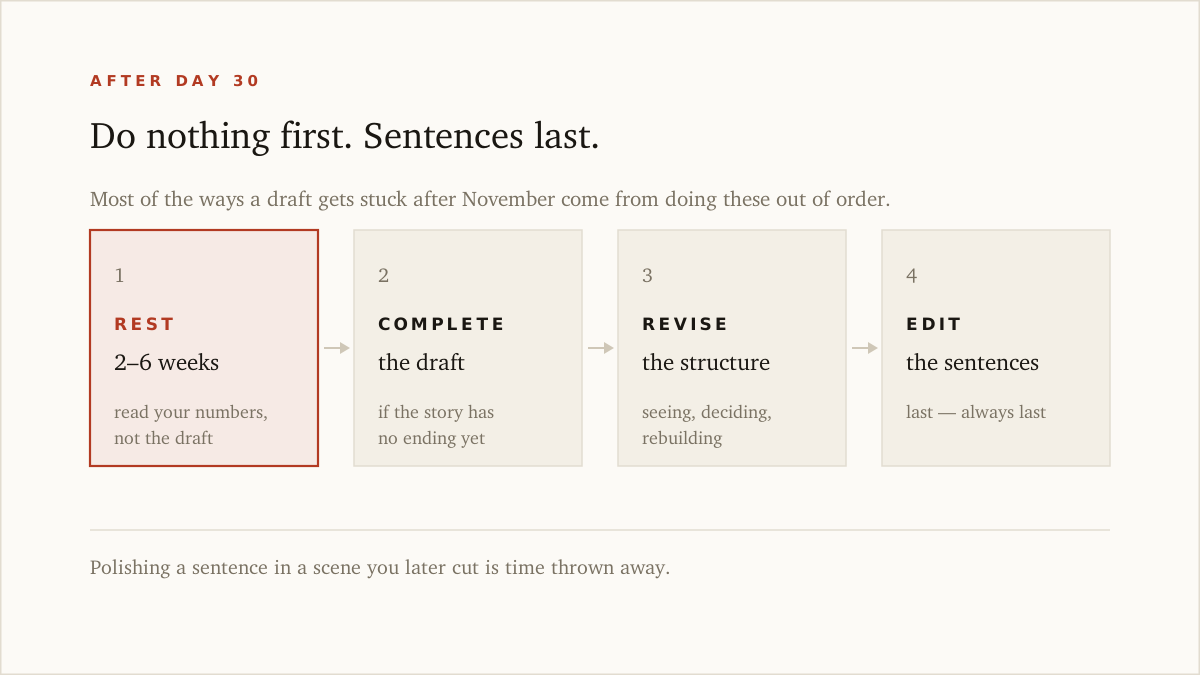
While the draft rests, it helps to understand what is ahead, because three quite different jobs get lumped together as "working on the book", and mixing them up is how drafts get stuck.
Complete the draft. If the story has no ending yet, or you drafted the first part of a longer book, the next job is still drafting: forward motion, the same habits as November, a sustainable daily count rather than a heroic one.
Revise. Change the book's structure and substance. Scenes move, go, or appear. Characters change. The middle gets rebuilt. This needs a different head from drafting — slower, more critical, looking at whole chapters rather than the next line.
Edit. Work on sentences. This comes last. Polishing sentences in a scene you will later cut is time thrown away, and it is the most tempting mistake in the whole process, because sentences are the part of the job with a visible edge.
Complete, then revise, then edit. Most of the ways people get stuck after a month-long draft come from doing those in the wrong order.
Why revision feels bottomless
Revision is where most month-long drafts go to die, and the reason is structural: the word covers too much.
"Revise the book" is not a task. It is at least five different tasks wearing one name, and they need different heads.
- Seeing — finding out what is actually on the page, as opposed to what you meant.
- Deciding — naming what the book is trying to be, because better is a comparison and you have not yet said with what.
- Rebuilding — fixing the shape: threads, promises, proportion, and the ending you have probably not earned yet.
- Finishing — length, consistency, and only then the sentences.
- Releasing — other readers, what to do with what they tell you, and the job nobody counts as a job: stopping.
Run those together and every session becomes a mess of all five, with no way of telling whether you are getting anywhere. Separate them, and each becomes a pass with an edge you can reach.
The first one is the one people skip, and it is the one the rest depend on. Before you change anything, read the whole draft through once without fixing a word — marking, not rewriting — so the read-through becomes a diagnosis instead of a demolition.
Open the parking lot
Somewhere in your files is the list of new ideas that turned up uninvited during November, each with a date on it.
Now is a good time to look. Some of them will seem much less exciting now that they are not competing with a hard middle. A few may still glow. If one does, give it a little time while the draft rests — notes, a rough map — but do not start drafting it. One book at a time.
If you didn't make it
If you did not reach Day 30, or you did but stopped writing long before it, none of this is about blame. Month-long drafts are hard, and life is not designed around them.
Whatever you have, it is more than you had on the thirty-first of October. The same order applies: rest it, read your numbers, then finish it at a pace your actual life contains.
And when the date comes round and you open the draft again, open your notes from the month first. Read what you knew then.
Then read the book.
The book this came from
The Rewrite
The month itself, and the weeks just after it, are covered by Thirty Days of Writing — including the rest, how to read your log, and what finishing means for each kind of fifty thousand words. The Rewrite takes over when you open the draft again.
Kindle · Paperback · included in Kindle Unlimited