Why Everything AI Writes Sounds the Same
The model is not being lazy, and it is not broken. It is doing exactly the thing it was built to do — and that is the problem you have to solve.
This article is the argument at the center of The Four-Day Novel — the honest method for writing fiction with AI. If your first AI draft came back smooth, competent and dead, the book is twelve chapters on why that happens and what to do instead, plus a full chapter on Amazon's disclosure rules and an annotated prompt library you can lift.
Run this before you read the rest. It takes two minutes and it will save you an argument.
Open any chatbot and type exactly this, with nothing else: Write the opening scene of a small-town romance novel.
Now, before you read what comes back, read this.
A woman drives into a small town. There is an excellent chance her name is Sarah, Emma, or Elena. It is probably autumn, and the leaves are probably doing something picturesque. She has recently left a city, a career, a fiancé, or all three. She stops at a charming local business — a bakery, a bookshop, a coffee place with exposed brick. A ruggedly handsome man is there. Their eyes meet. Somewhere in the prose, light is dappled and coffee is rich.
Go and read yours.
I am not psychic, and this is not a trick. It is the whole mechanism, and once you see it you cannot unsee it.
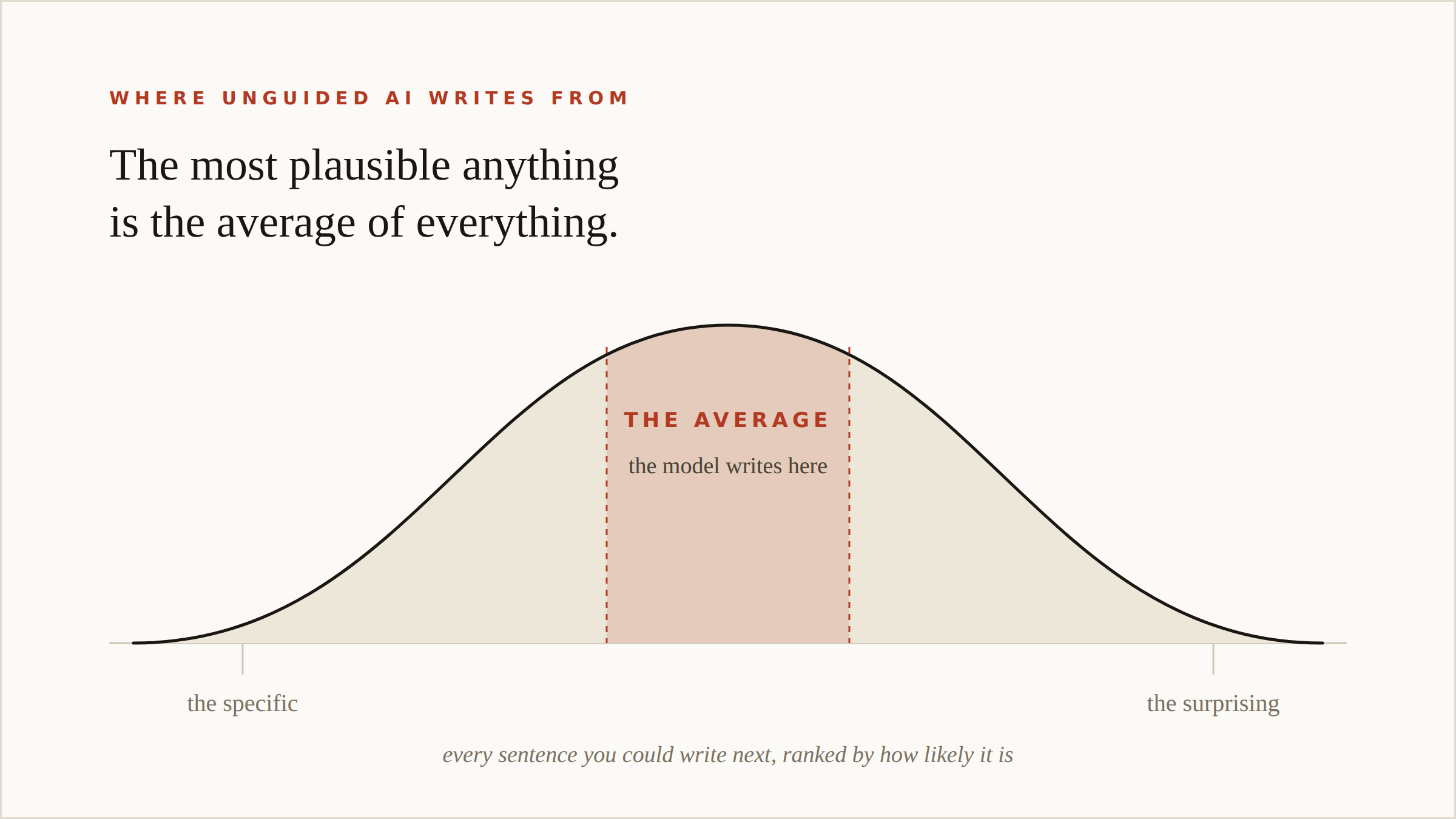
The most likely next word is the most average one
Here is the plainest useful description of what a language model does.
It has read a staggering share of the text humanity has produced, and from all that reading it learned one skill to superhuman depth: given some text, predict what plausibly comes next. When it writes, it is performing that prediction over and over, word after word. There is no story in its head. No intention. No taste. There is only, at each step, a ranked sense of what usually follows.
Sit with that word. Usually.
When you type "write me a romance novel" and nothing else, you have asked for the most plausible romance novel. And the most plausible anything is, by definition, the average of everything the model has read. The most expected meet-cute. A heroine assembled from the mean of ten thousand heroines. Plot turns you can see three chapters out — not because the machine is stupid, but because it is doing precisely what you asked. It is giving you the statistical center of the genre.
Writers already have a word for the statistical center of a genre.
The word is cliché.
The obvious objection, which is half right
At this point the reasonable response is: fine, so write a better prompt. Be specific. Tell it the heroine is a fifty-year-old harbor pilot with a gambling problem and set it in February.
That works, and you should do it, and it is not enough — for a reason worth being precise about.
A better prompt does not take the model off the average. It moves the average somewhere more interesting. Ask for the harbor pilot and you will get the most likely harbor-pilot story: competent, plausible, and still the middle of a distribution, just a smaller and more flattering one. Do it for eighty thousand words and the flatness comes back, because you were never fighting one bad output. You were fighting a gravitational pull that acts on every sentence you generate.
Prompting is steering. It is not escape velocity.
It happens at three levels, and people only notice one
Most writers notice the plot problem, because it is the loudest. The averaging is actually happening in three places at once.
At the level of the word. Unedited machine prose has a recognizable flavor even when nothing is technically wrong with it. There is a small family of words it reaches for far harder than people do. There is a rhythm where everything arrives in threes. There is the construction it wasn't X, it was Y, deployed until it stops meaning anything. There is a metaphor sprayed over every available surface.
At the level of the sentence. This is the one readers feel and cannot name. They grope for words in forum threads and keep landing on the same ones: smooth but empty. Confident about nothing. Like it was written by someone who has read a thousand books and felt none of them. One reader called it prose with the bones removed.
The uncanny thing about machine writing is exactly its frictionlessness. Human prose has grain — odd word choices, rhythms that stumble on purpose, sentences that take a risk and half-fail. The model, always betting on the most probable next word, sands all of that away and hands you something with the texture of a stock photo.
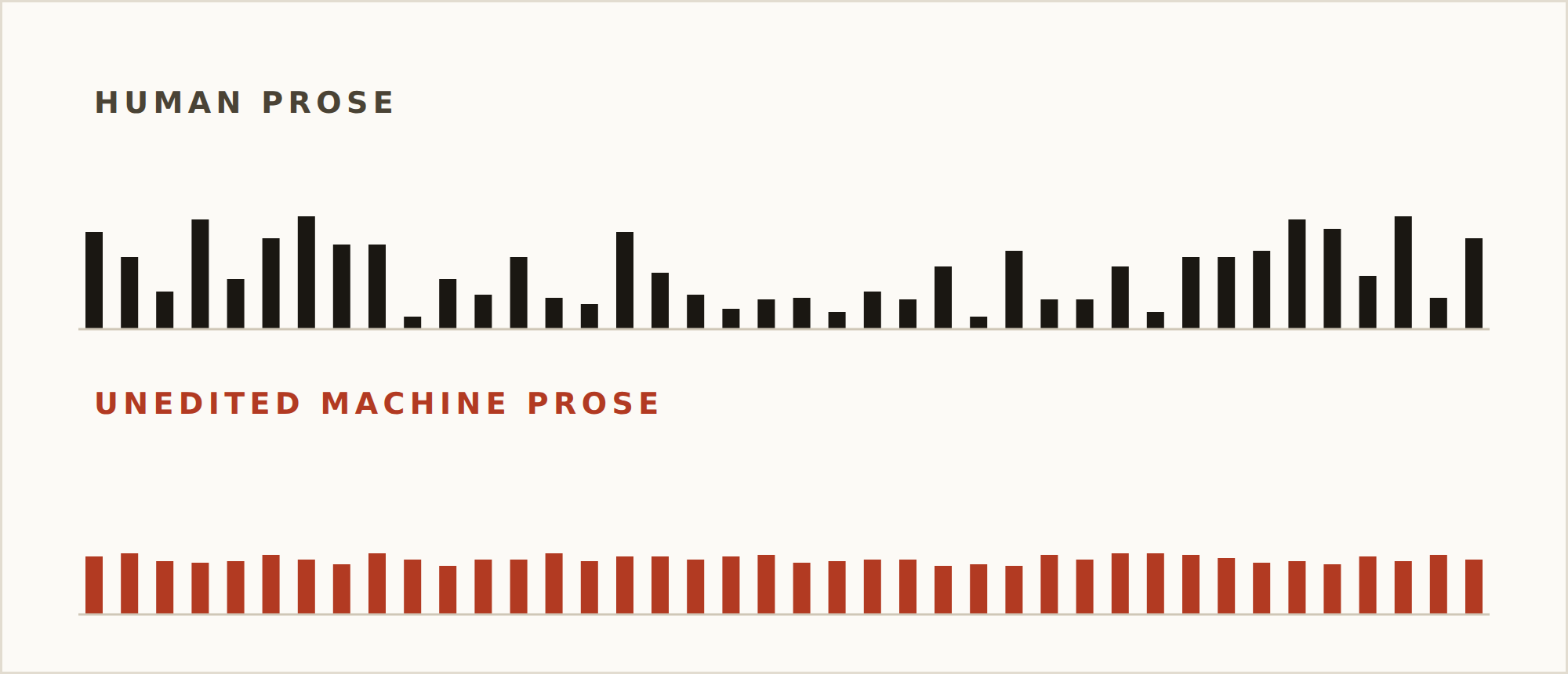
At the level of structure. The three-act shape it did not choose, arriving where the genre average says it should, resolving the way the mean of ten thousand books resolved.
Fix the vocabulary and leave the other two and you have polished a hollow thing. That is why find-and-replace on the word delve is not a method.
What readers are actually detecting
Here is the part that reframes the whole problem.
When readers accuse a book of being machine-made, look closely at their evidence posts — the ones where they quote a passage and explain what tipped them off. They are almost never detecting a machine. They are detecting the absence of a person.
You can prove this from the false positives. Human authors with clean, fast, commercial styles get accused constantly. Writers who love an em dash too much. Writers whose publisher's schedule produced three books in a year. They get told to prove they wrote their own book, which is an argument nobody can win, because there is no satisfying answer to it.
Notice what triggers those accusations. Smoothness. Speed. Genericness of style. The crowd is pattern-matching on voicelessness — and voicelessness is not a property of tools. It is a property of unedited text, from any source.
Which means the thing you are trying to avoid is not "sounding like AI."
You are trying to avoid sounding like nobody.
So what actually pulls it off the average
Three things do the work. In my experience the first one does most of it, and it is the one nearly everybody skips.
A style sheet built from your own writing. Not a description of the voice you want — a specimen of the voice you have. Paste in several thousand words you actually wrote, and derive from it the concrete, checkable rules: your average sentence length, whether you use fragments, how you punctuate dialogue, the words you never use, the rhythm you fall into when a scene turns. That document is the single strongest counterweight to the average, because it replaces "the mean of everything" with "the mean of you." Skip it and nothing downstream will sound like you. Nothing.
Structural authority you keep. An outline you built and then argued with, chapter by chapter, overruling the machine's suggestions where they are merely the expected thing. The moment the shape of the book comes from the model, the book is the average again no matter how good the sentences are.
A real line edit, on every line. Not a proofread. The pass where you go through what came back and change it until it is yours — cutting the third item in every list of three, breaking the rhythm on purpose, replacing the competent metaphor with the odd true one. This is where the book actually gets written, and it is the step that separates every good outcome from every embarrassing one.
There is a pattern to those three. None of them is a prompt. All of them are constraints.
Constraint is not the enemy of working with a model. Constraint is the entire job.
The five questions
Every AI-publishing horror story you have read — the novels shipped with the chatbot's refusal still sitting in the text, the guides written by no one who had been anywhere — has the same autopsy finding. Not "the author prepared carefully and the machine betrayed them." That failure mode barely exists in the record.
What exists, every time, is the author's job left vacant. The human stopped reading.
So before anything ships, ask five questions of it:
The slop self-test
- Have I read every page of this, myself, in its final form?
- Does it have a voice a reader could pick out of a lineup?
- Did a structure I chose — not the model's default — decide what happens in it?
- Would I be comfortable if a reader asked me directly how it was made?
- Is there any page of it I am hoping nobody looks at too closely?
The first four want yes. The last one wants no.
Every disaster fails at least three of them. Most fail all five. And that is the quietly enormous good news buried in all of this: the bar set by the failures is on the floor, and care has never been easier to notice.
Slop is a process failure, not a technology one. It describes what happens when nobody did the author's job.
Do the job, and the problem in this article is not yours.
The book this came from
The Four-Day Novel
The book takes the five moves in the last section and turns each one into a procedure you can follow on a specific morning — the style sheet, the story bible, the outline you argue with, the chapter loop, and the line edit that actually writes the book. It also covers the parts nobody else will tell you: what KDP asks you to declare, what detectors can and cannot see, and where the genuinely hard cases sit.
Kindle · Paperback · included in Kindle Unlimited