Can You Publish a Novel Written With AI on Amazon?
Yes. The rule is not the one most writers think it is, and the dangerous position is not the one they are worried about.
This is a compressed version of one chapter of The Four-Day Novel — the honest method for writing fiction with AI. If you want the rest of it, the book is twelve chapters on producing a manuscript you can defend: how to keep the voice yours, how to keep the structure yours, and how to answer the disclosure question with a straight back.
The short answer is yes, and it has been yes for a while.
Amazon does not prohibit AI-assisted or AI-generated books on Kindle Direct Publishing. What it asks is that you tell them about it when you publish, and it caps how many new titles an account can upload in a day. That is the whole architecture of the rule.
The longer answer is where the useful part lives, because almost everything writers believe about this is folklore, and the folklore is wrong in a direction that gets people into trouble.
One caveat before any of it. Platform terms move, and a paragraph written today about a policy page is a paragraph with a shelf life. Everything below is the shape of the thing and the questions to ask. Read KDP's current content guidelines the week you upload, not this article, and not a forum post from 2024.
The two categories, and where the line falls
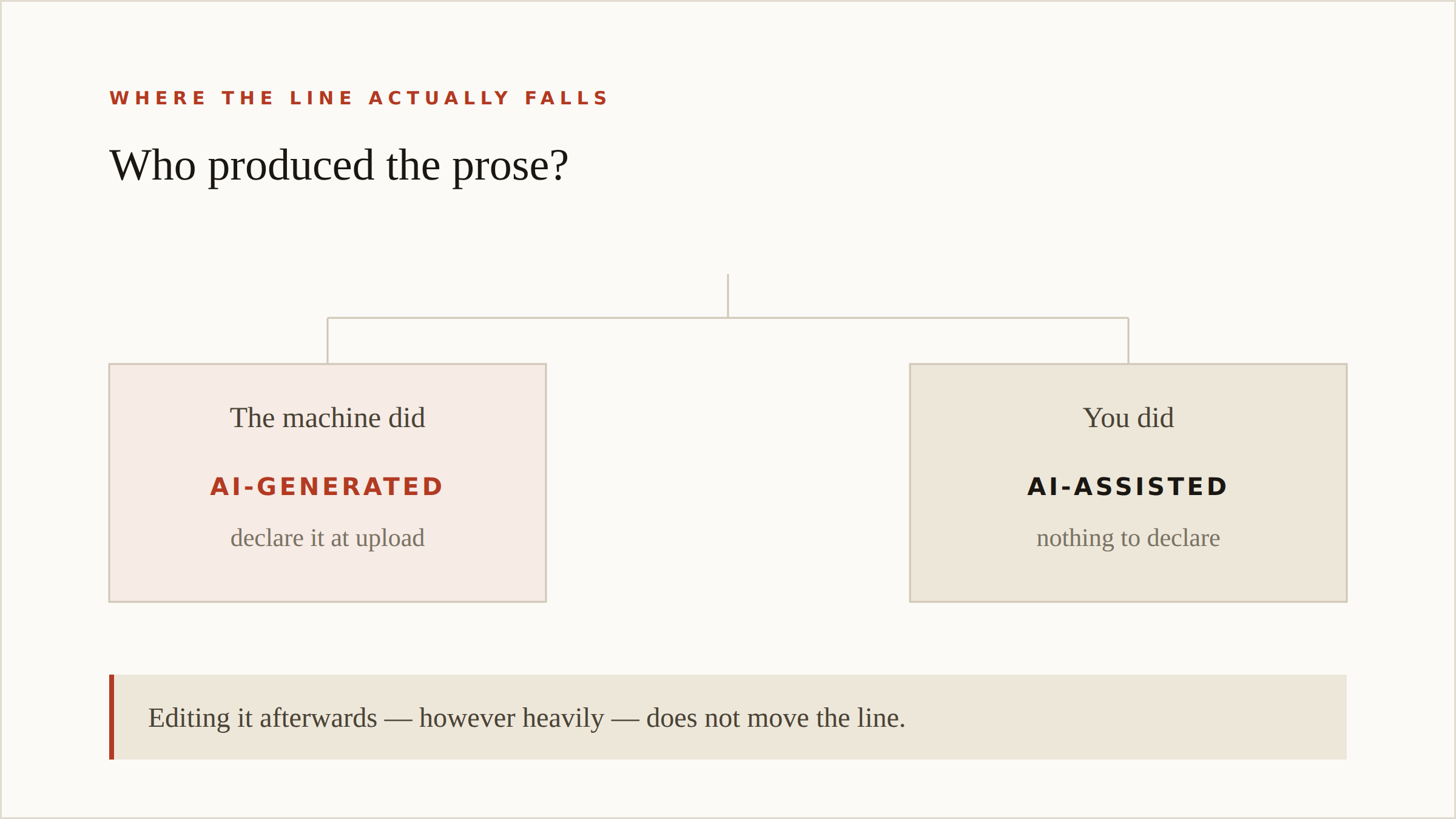
At publication, the KDP workflow asks whether your book contains AI-generated content. Amazon draws a distinction between two things, and the distinction is about who produced the actual words.
AI-generated means the tool produced the text, the images or the translations themselves.
AI-assisted means you created the content and used AI to edit, refine, brainstorm or check it.
Here is the part that surprises people, and it is the single most misunderstood sentence in this whole area: editing afterwards, even substantial editing, does not move a book from generated to assisted. If the machine produced the prose and you then line-edited every sentence of it, that is still AI-generated under Amazon's definition. Your edit is enormous and it is what makes the book good, but it is not what the classification turns on.
So run your own process against it honestly.
If a model drafted your chapters and you rewrote them line by line, the chapters are AI-generated and disclosable. Your outline is yours, your characters are yours, your voice is yours, and the box still gets checked, because the question is about the prose.
If you wrote the prose yourself and used a model to brainstorm, interrogate an outline or catch repetitions, you are in AI-assisted and no declaration is required.
Classify from what actually happened rather than from what sounds better. And where a mixed process makes it genuinely ambiguous — you drafted some chapters by hand and generated others — disclose rather than understate. Nothing bad happens when you over-declare.
What happens after you check the box
This is where the folklore does the most damage, so let me be plain about it.
Nothing happens.
The declaration goes to Amazon, in your publishing dashboard. It does not appear on your product page. Shoppers do not see it. Amazon has stated that it does not affect royalties or ranking. A properly disclosed book publishes exactly like any other book.
What the checkbox actually is, from Amazon's side, is data-gathering while the policy is still being shaped. From your side it is insurance.
Because here is the asymmetry that matters:
The dangerous position on KDP is not "AI book, disclosed." It is "AI book, undisclosed."
The first is a routine form field. The second converts a checkbox into a terms-of-service violation attached to your entire account — every book on it, not just the one. That is a bad trade for the sake of avoiding a click nobody will ever see.
What actually gets accounts closed
Worth separating from the disclosure question entirely, because writers conflate the two and end up frightened of the wrong thing.
Accounts get closed for volume abuse — the spray-and-pray operators uploading dozens of titles a week. For copyright problems, including the people who published books under other authors' names to skim their readerships. And for content that breaks the guidelines in the ordinary ways that have nothing to do with how it was drafted.
The daily upload cap exists because of those operators. The disclosure requirement exists partly because of them too. You are, unavoidably, publishing into a regulatory environment they created — which is annoying, and is also just the terrain.
Note what is not on that list: writing a good book with a model and saying so.
The traditional-publishing door is a different question
If your plan is agents and publishing houses, the calculation is not the same, and I would rather tell you plainly than let you find out at query stage.
Publishing contracts have always required authors to warrant the originality and authorship of the work. Since the AI era began, agencies and houses have been adding language that names AI directly, and submission guidelines increasingly ask outright. You cannot sign a warranty you know to be false — that is not a gray area — and disclosing the method at query time is, in the current climate, a rejection in most rooms regardless of what the pages are like.
There is a second reason the door matters less than it looks, and it is about you rather than them. United States copyright protects human authorship. Purely machine-generated material is not copyrightable; the human contributions — the selection, the arrangement, the creative choices, which in practice means your outline, your invented specifics and every line you edited — are where your protectable interest sits. That is general information rather than legal advice, the guidance is still evolving, and if it bears on your situation the current original is worth reading.
A publisher acquiring rights wants clean, warrantable goods. Indie publishing does not require anyone to acquire anything — you are not selling rights, you are selling books.
If traditional publishing is the dream, the honest advice is to write that book by hand and use everything in the method that is not generation: the interrogation brainstorm, the story bible discipline, the shelf research. That is a real productivity gain and it raises no disclosure question at all.
The rule underneath all of it
Strip away the mechanics and one principle carries the whole thing.
You never lie. Not to the platform, not to readers, not to yourself.
That does not oblige you to lead your marketing with your tool chain. No author lists their word processor or their developmental editor in the blurb, and how a book was manufactured is not the product. Note the asymmetry carefully, because it is the entire playbook:
Silence is a right. Falsehood is a forfeit.
There is one specific sentence that ends careers, and it is "written one hundred percent by hand, no AI" — written by someone for whom it is not true. Never write it, never imply it, and never let a marketing reflex draft it for you.
The writers who get destroyed in these episodes are almost never destroyed for using a model. They are destroyed for shipping something nobody read before charging money for it, or for lying when asked, or both.
What to do this week
If you are close to uploading:
- Read KDP's current content guidelines yourself. Not a summary. The actual page.
- Decide your classification from what you actually did, and lean toward declaring.
- Keep the receipts — your outline, your story bible, your continuity notes, your edit history. Dated files are a better answer to an accusation than any detector score, because they show the work.
- Check your marketing copy for the sentence in the last section. Then publish.
Answer the question truthfully and the whole thing turns out to be a checkbox.
The book this came from
The Four-Day Novel
Chapter 12 of the book goes through all of this properly — the decision tree for the declaration, the playbook for a public accusation, the receipts folder worth keeping, and the reason traditional publishing is a separate calculation. The eleven chapters before it are about making a book worth defending in the first place.
Kindle · Paperback · included in Kindle Unlimited