What AI Detectors Actually Measure — and Why They Flag Human Writing
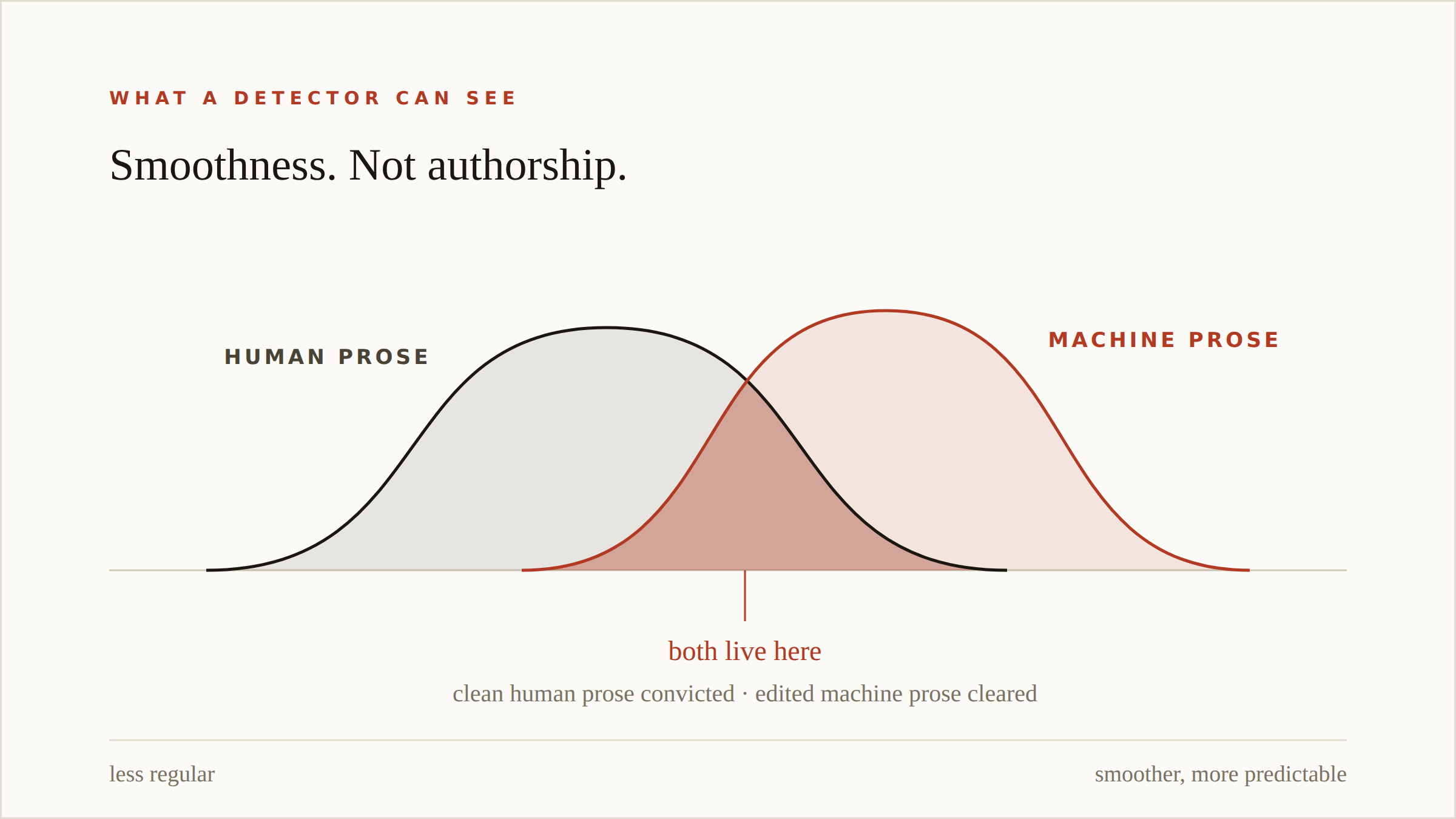
They are not lie detectors. They are smoothness detectors, which is why clean, fast human prose keeps getting convicted.
This comes out of The Four-Day Novel, the honest method for writing fiction with AI. The book's whole argument is that the thing detectors are groping for — a distinctive human voice on the page — is something you build deliberately, with a style sheet and a line edit, rather than something you hope survives. Twelve chapters, plus an annotated prompt library.
Here is an experiment worth running before you worry about this any further.
Take something you wrote entirely by hand, years ago, long before any of this existed. A finished chapter, an old essay, a piece you know the provenance of down to the afternoon. Put it through a free AI detector.
A great many writers who try this get a number back that would convict them.
It is a strange feeling, and it is also the most useful thing you can learn about these tools, because it tells you immediately what they are and are not measuring — and that turns out to say more about how to write well than any amount of detector-chasing will.
What the tools are actually doing
An AI detector is a pattern-matcher. It estimates whether a piece of text looks statistically like model output. It is not reading for meaning, it has no access to your drafts, and it cannot know anything about how the words got there.
What it can measure is regularity. How predictable is the next word given the ones before it? How uniform are the sentence lengths? How evenly distributed is the vocabulary? How rarely does the prose do something surprising?
Model output scores high on all of those, for a reason that is not mysterious: a language model works by predicting the most probable next word, over and over. Prose built that way is, by construction, unusually close to the statistical center of the language.
So the detector is looking for smoothness. It finds it in machine text because machine text is smooth.
And it finds it in some human text too.
Why the false positives look the way they do
Look at who gets accused.
Writers with clean, fast, commercial styles. Writers who came up through genre fiction, where the house style rewards prose that gets out of the way. Non-native English speakers, whose sentences are often more regular because they were learned as rules rather than absorbed as noise. Writers who love an em dash a little too much. Writers whose publishing schedule produced three books in a year, which readers take as evidence of a machine rather than of a professional.
None of those people did anything wrong. They wrote prose with low variance, and low variance is the whole signal.
Then look at what happens next, because the second-order problem is worse than the first. Being accused is an argument you cannot win. Prove you wrote this has no satisfying answer. There is no artifact you can produce that a determined accuser will accept, and every defense sounds like the defense a guilty person would offer.
This is why the detector question is not really a technical question. It is a reputational one.
The error runs the other way too
Detectors also clear machine text. Routinely.
Any output that has been through a real line edit — sentences broken on purpose, the third item cut from every list of three, the competent metaphor swapped for the odd true one, an actual voice imposed over the top — moves away from the statistical center in exactly the dimensions the detector measures. Not because anyone was gaming it, but because that is what editing does.
Which produces the awkward summary: the tools are unreliable in both directions, and they are least reliable precisely where the stakes are highest.
If you want to see the size of the effect, run the experiment on your own files. Take a raw first draft of a chapter and the version you edited, and put both through the same free detector. The gap between the two scores is your edit, quantified. It is usually much larger than people expect, and it is the most useful demonstration I know of what a line edit actually does to prose.
Do not write for detectors
This is the practical instruction, and it is the one people resist.
Detector-chasing is a treadmill. The tools change monthly, they disagree with each other, and any specific trick that lowers a score today is a trick the next version has been trained on. You would be optimizing for evasion, permanently, against a moving target.
Worse, it corrupts the work. Once you start writing to fool a classifier you start making choices for reasons that have nothing to do with the reader — inserting artificial roughness, avoiding a clean sentence because clean sentences score badly, second-guessing your own instincts against a number.
And it is unnecessary, because the two objectives already point the same way. Everything that makes prose read as human — specific detail, irregular rhythm, a voice with fingerprints on it, sentences that take a risk and half-fail — is what makes prose good. You do not need a detector strategy. You need a voice, and the voice is worth building for its own sake.
Write for readers. The scores follow as a side effect.
What readers are detecting, which is not the same thing
Here is the part that reframes the whole anxiety.
When readers accuse a book of being machine-made, read their evidence posts — the ones where they quote a passage and explain what tipped them off. They are almost never detecting a machine. They are detecting the absence of a person.
Voicelessness. Prose that is smooth and empty. Confident about nothing. Competent sentences arranged in a competent order with nobody behind them.
That is not a property of tools. It is a property of unedited text from any source, and it is entirely fixable by the person holding the manuscript.
Which means the defense against the accusation is the same as the defense against the underlying problem, and both are just: be on the page.
If it happens to you
Decide this now, while you are calm, because the middle of a thread is a bad place to improvise.
Do not rush to the replies. Accusation threads run on author panic. Most of them pass in days if nothing feeds them.
Respond once, if at all, in your own space. Your newsletter, your author page. How you work, in a sentence. That you stand behind every page. Done. No heat, no thread-by-thread rebuttal.
Never post a detector score as exoneration. This is the one people get wrong, and it is worth being emphatic about. If you cite a favorable score as proof, you have publicly endorsed the coin-flip machine — and the next author it convicts, possibly you, now has your endorsement quoted back at them. Do not hand the tool authority it has not earned, even when it is on your side.
Keep receipts. Your outline, your story bible, your continuity notes, your dated draft files. If a platform ever asks, that folder is a complete, boring, factual answer, and boring is exactly what you want in that correspondence. It is a better defense than any score, because it shows the work.
Then go back to the book you are writing. Every author who survived one of these survived it by still being there, still publishing, when the thread was three controversies stale.
The short version
Detectors measure smoothness and call it authorship. They are wrong about human writers often enough to have ruined people's weeks, and wrong about machine writing often enough to be useless as enforcement.
You cannot control what a classifier says about your sentences. You can control whether there is anybody in them.
Do that, and the score becomes somebody else's problem.
The book this came from
The Four-Day Novel
If detectors worry you, the useful response is not evasion — it is a manuscript with your voice on every page, which the book spends Chapters 4 and 9 teaching you to produce. Chapter 12 covers the accusation playbook, what to keep in a receipts folder, and how to answer a platform that asks.
Kindle · Paperback · included in Kindle Unlimited