How to Build a Style Sheet From Your Own Writing
The step almost everyone skips, and the one doing most of the work. It takes an evening, and nothing downstream sounds like you without it.
This is the first real move in the method laid out in The Four-Day Novel — the honest book about writing fiction with AI. Everything else in that book controls what the machine writes; this controls how it sounds, which is what a reader actually experiences for ten hours. The book has the full build, the annotated prompts, and the eleven chapters that follow from it.
Cover the author's name on a page of fiction, hand it to someone who has read that author before, and ask whose it is. For a writer with a real voice, readers get it right at eerie rates. They know a Terry Pratchett footnote at fifty paces. They can smell Cormac McCarthy from the punctuation alone, or rather from its absence.
Call it the lineup test. It is the thing you are protecting, and it is the first thing to go when a machine is doing the typing.
Not because the machine writes badly. Because it writes averagely, and the average has no fingerprints.
There is exactly one way to fix that, and it is not a better prompt. You write your voice down, explicitly, as a document, and you hand that document over with every single drafting request.
That document is a style sheet. Here is how to build one in an evening.
What a style sheet is not
It is not adjectives.
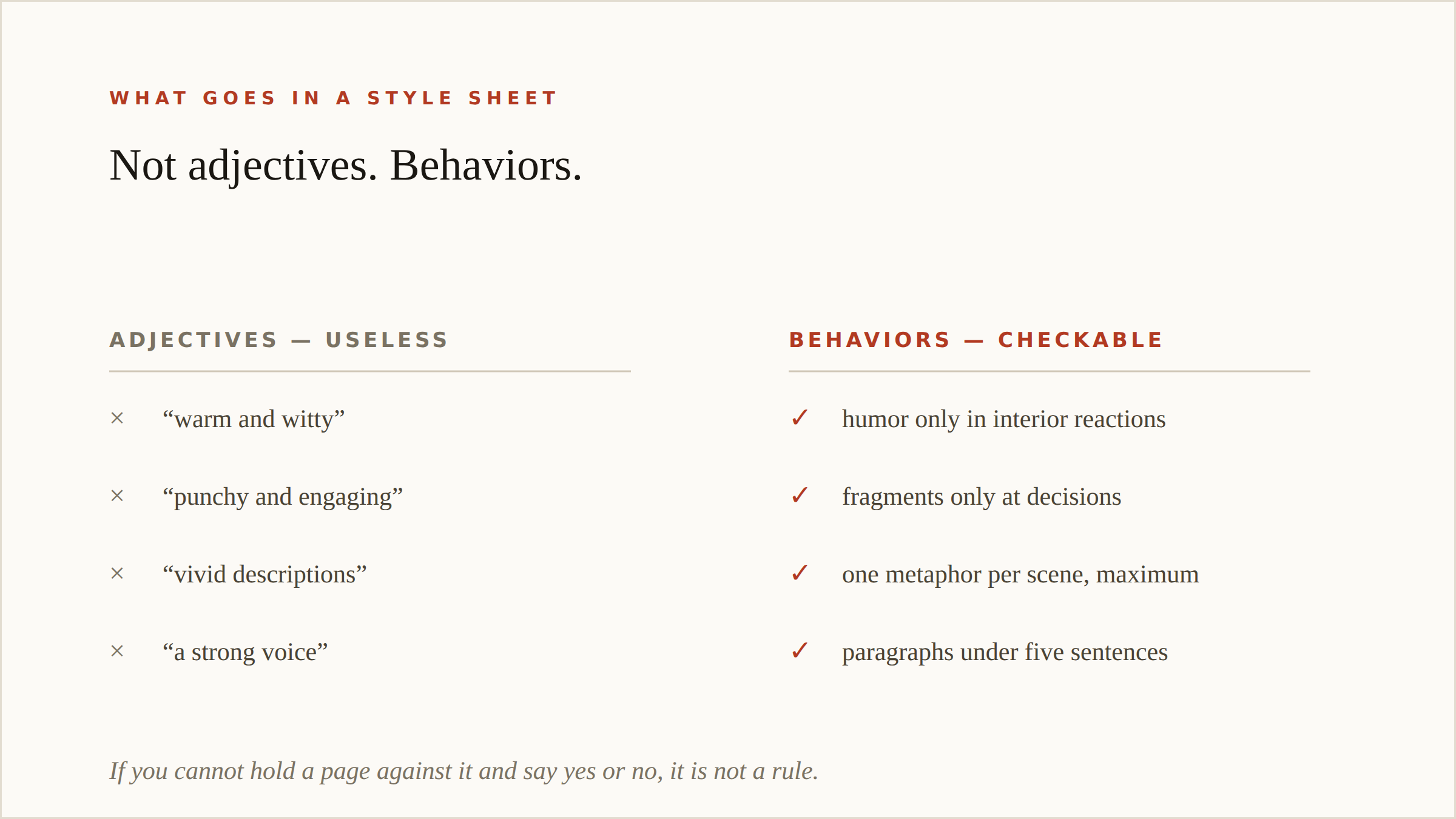
"My voice is warm and witty" is useless to a machine, and honestly useless to a human collaborator too. It describes a feeling about the prose rather than anything the prose does.
Compare: "Humor lives in the viewpoint character's interior reactions, never in narrator asides."
That is an instruction a drafting partner can follow and an editor can check. When a draft comes back with a wry narrator, the sheet has been violated and you know exactly what to cut.
The entire craft of the style sheet is converting the felt sense of your voice into checkable behaviors. Every line should be something you could hold a page against and say yes or no.
What goes in it
Six areas, minimum.
Rhythm. Your sentence-length pattern and where it breaks. Long and rolling, or short and punching? Where do fragments appear — at emotional beats, in action, never? How long do your paragraphs run, and what makes you break one early?
Dialogue-to-narration ratio. Some voices carry scenes almost entirely in talk; others narrate heavily and use dialogue as seasoning. The machine has a default ratio — a bland middle, naturally — and it will use it unless told otherwise.
Interiority. How deep inside the viewpoint character's head does the prose live? Are thoughts direct, filtered, or absent? How often does the narration step back?
Description. What kind of details does your eye select? Lyrical imagery, or working detail — what things cost, what is broken, what someone's hands are doing? How much description per scene before you get impatient?
Humor. Where it lives, what flavor, how often. This one drifts fastest, because the machine's default humor is a gentle universal smirk belonging to nobody.
Punctuation and vocabulary habits. Em-dash addict or semicolon loyalist? Words you lean on, words you would never use. And the negative list, which gets its own section below.
The four-step build
Step one: gather the evidence. Collect two to five thousand words of your own best prose. Finished scenes, not notes. Writing you would stand behind, in roughly the register of the book you are about to write — your cozy voice and your thriller voice are different animals, and the sheet should describe the one on duty.
Step two: have the machine profile you. Paste the samples into a fresh chat and ask for analysis, not flattery. Ask it to describe the writing across the dimensions above, with two rules attached:
- Describe behaviors, not qualities. "Uses fragments at moments of decision", not "punchy and engaging".
- Quote an example from the sample for every claim.
The second rule is the one that matters. It forces the analysis to stay attached to your actual pages instead of drifting into horoscope territory, where every description is vaguely true of everyone.
Step three: argue with the profile. This is the step people skip, and it is where the sheet becomes yours.
The machine's read of you is a decent first draft and reliably wrong in places. It will overweight whatever your sample happened to contain and miss habits you know you have. Go through every line. Strike what is wrong. Sharpen what is mushy. Add what it missed.
You are the only living expert on your own voice. The machine just saved you the blank page.
Step four: add the law. Convert the finished profile into imperative sentences — instructions a drafting partner must obey — and append the negative list. Save it as a standing document. From now on it rides along with every drafting prompt you send, and it gets amended every time an edit teaches you something new about your voice.
What one looks like when it is done
Compressed, the working core of a sheet reads something like this:
Deep third person, past tense, one head per scene. Sentences run medium and plain; fragments appear only at moments of decision or recognition, never for decoration. Paragraphs stay under five sentences. Dialogue carries scenes; narration between speeches stays lean and physical — what hands and objects are doing. Humor is dry and self-directed and lives in interior reactions; the narrator itself is never funny. Describe through working detail: costs, repairs, weights, what is broken and how badly. One metaphor per scene, maximum, and it should be slightly wrong in a way the viewpoint character would notice. Sentimentality is earned only through specifics; the prose never announces an emotion it can show.
Notice what that is. Not a description of good writing in general — a description of one voice, checkable line by line. Three metaphors turn up in a scene and the sheet has been broken. That checkability is the entire point.
The negative list
The second half of your sheet is a list of the machine's own habits, banned by name. You need it twice: once in the document as prohibitions, and once in your head as a trained ear.
The contrastive hook. "It wasn't just a building. It was a promise." The machine adores this negate-then-reframe rhythm — it sounds profound and costs nothing. Delete the negation, keep whichever half is true, or cut the slogan and show the thing.
The rhetorical question with an instant answer. "What was she supposed to do with eleven rooms and a leaking roof? She had no idea." A fake beat of suspense, resolved before anyone can care.
The triple list. "Warm, cluttered, and full of memory." Everything arrives in threes whether or not the content has three parts, because the cadence is pleasing. Pick the item doing real work — usually the last — and give it a whole sentence.
The vocabulary. A small family of words appears at rates no human matches: delve, tapestry, testament, myriad, palpable, unwavering, bustling, nestled. Towns are forever nestled; silences are forever palpable. None of these words is wrong. The frequency is the tell.
Metaphor overload. Three figures in three sentences, each competing, none earning its place. Cut most of them and keep the one that is working.
Inflated stakes. "In that moment, everything she believed about her life began to shift." No it didn't; she found a roof leak. Match the register to the event and save the big language for the four or five moments that have earned it.
The floaty generalization. "The town had a charm that was hard to describe." Land the plane. One concrete detail — the hardware store still selling nails by the pound — outworks a paragraph of charm-that-is-hard-to-describe.
The bow-tied ending. The machine cannot bear to end a chapter without wrapping it in ribbon: a tidy realization, a hopeful chord, a moral. Real chapters end on friction. Delete the last paragraph of almost every AI-drafted chapter and end one beat earlier. Write the true last line yourself — last lines are yours.
Two honest notes. None of these constructions is exclusively a machine habit; humans wrote them all first, which is where the machine learned them. The list bans defaults, not tools. And the specific tells drift as models change, which is one more reason the sheet is a document you amend rather than a chapter you read once. Your ear is the permanent asset. The list is just its current notebook.
If you have nothing to sample
Two honest options.
The better one: write three scenes by hand first. Yes, really. It costs a few hours and it is the difference between a voice and a costume. Aim them at your actual book and they do double duty as voice evidence and story discovery.
The workable alternative: build an aspirational sheet by profiling two or three published authors whose register you want to live near, then blending the behaviors you admire into a specification.
One bright line there. An aspirational sheet borrows behaviors — rhythm patterns, dialogue ratios, description habits. It never borrows an identity. "Lean narration, dialogue-forward, dry interior humor" is a legitimate register to write in. "Write like [famous author]" is a costume, it produces imitation rather than voice, and it is also precisely the instruction that ends up as a screenshot.
Voice drift, and the calibration read
One more thing, because you will meet it around chapter ten and it helps to know it is coming.
Even with the sheet riding along faithfully, generated prose drifts back toward the mean. The fragments get a little more frequent because the machine noticed you kept some. The metaphors creep from one per scene toward two. The dialogue smooths. No single chapter crosses a line — the drift is a slope, which is exactly what makes it dangerous, because your ear acclimatizes along with it.
The cheap fix is a periodic calibration read. Every eight or ten chapters, put your newest edited chapter beside one of the original hand-written sample scenes and read them aloud, back to back. If the new one has gone smoother, safer, more pleasant and less yours, tighten the relevant lines of the sheet, re-edit the last two chapters against the tightened law, and carry on.
The sheet does not just describe your voice. It defends it.
The book this came from
The Four-Day Novel
Chapter 4 of the book is this, at full length, with the complete field guide to the machine's tells and the prompts that build the sheet. Chapter 9 is the other half: the line edit where the sheet becomes a checklist and the book actually gets written.
Kindle · Paperback · included in Kindle Unlimited