What Is Speculative Fiction?
"Anything that isn't realism" is accurate and useless at the desk. It tells you what your book isn't. Here is a definition you can actually build with.
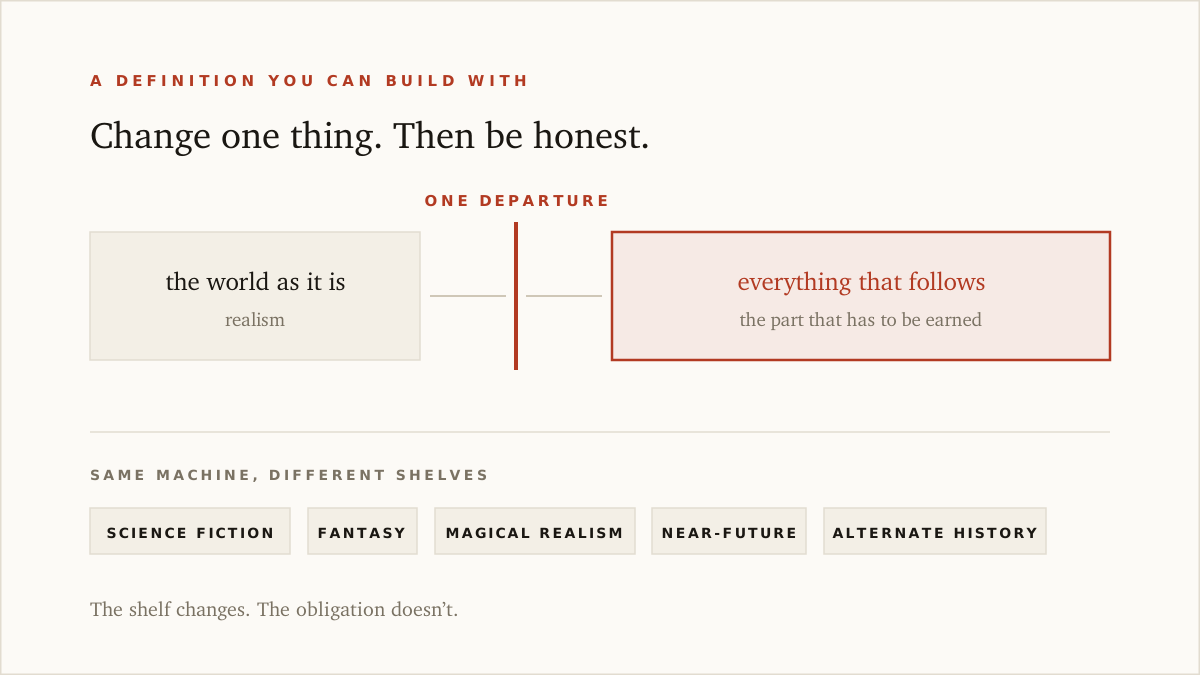
This is the opening argument of How to Write Speculative Fiction, the short guide built on one idea — one impossible thing, and everything that follows. Eight chapters, each ending with a test called the Ripple that you run on your own manuscript.
Agents ask for speculative fiction constantly. Submission pages list it. Editors say they are looking for it. And almost nobody explains what they mean, because the standard definition is a boundary rather than a description.
Speculative fiction: fiction that departs from reality. Anything that isn't realism.
That is accurate. It is also no help whatsoever at a desk on a Tuesday. It tells you which enormous pile your book is in. It does not tell you what the pile has in common, what readers of it are expecting, or what to do when your draft feels thin.
A definition you can work with
Speculative fiction changes one thing about the world, then tells the truth about what happens next.
Both halves matter, and the second one is where the work is.
The first half is the easy part and the part writers enjoy. A departure from the world as it is: the dead can be visited for an hour, the ice did not melt, a city keeps its memories in a building, people stop being able to lie. Nobody struggles to generate these.
The second half is the obligation. Having changed one thing, the book is bound to be honest about the consequences — not just the exciting ones, but the dull, institutional, domestic ones. Who profits. What gets regulated. What the insurance looks like. What a mother tells a child about it. Which jobs stop existing and which embarrassing new ones appear.
Your reader will grant you the impossible thing almost for free. Everything after it has to be earned. That asymmetry is the whole craft, and the aftermath is where most speculative manuscripts quietly fail — not in the idea, which is usually good.
How it relates to science fiction and fantasy
This is the question underneath most searches for the term, and the honest answer has two parts.
As a category word, speculative fiction is the umbrella. Science fiction, fantasy, magical realism, alternate history, near-future, dystopia, horror with a supernatural premise — all of them depart from the world as it is, so all of them sit under it. By that reading, asking whether your book is speculative or fantasy is like asking whether an animal is a mammal or a dog.
As the word agents actually use, it is narrower. In submission practice, speculative usually signals a book that takes one impossible element but otherwise reads like literary or contemporary fiction — prose-forward, character-driven, without the furniture of a genre shelf. No magic system with rules to learn. No starship crew. One departure, deeply followed, in a world that otherwise looks like this one.
That second usage is why the word is so often the honest label for a manuscript that has been getting called unclassifiable. If your novel keeps being described as "literary but there's the thing with the river", speculative is probably what you are reaching for.
What it is not
It is not a soft word for science fiction. Writers sometimes reach for speculative because it sounds more respectable, which readers and editors can both smell. If your book has spaceships and a hard technological premise, calling it speculative does not elevate it; it just sends it to the wrong agents.
It is not world-building. A world is not the same as a departure. You can build four hundred pages of geography and still have changed nothing about how people live, which produces the manuscript that gets called immersive and aimless.
It is not a licence for more than one impossible thing. Nothing forbids a second departure. But each one spends reader credit, and a book with three unrelated impossibilities usually has none of them followed properly — which is the real reason thin worlds feel thin.
The test
Take your draft and answer two questions.
One: what is the single departure your story could not exist without? Not the most interesting one. The load-bearing one. If you removed it, would there still be a book? If yes, you have not found it yet.
Two: name three consequences of it that are boring. A law. A job. A family argument. A piece of paperwork. If you cannot produce three, the aftermath is not built, and that is almost certainly what readers mean when they say the book is lovely but did not feel fully realised.
The second question is the uncomfortable one, and it is the one that separates a premise from a novel.
Why the label is worth getting right
A label is a promise made before anyone opens the book.
Pitch a quiet, character-driven novel with one strange element as fantasy and it reaches readers who wanted a system and a map, and will say so publicly. Pitch it as literary fiction and it reaches readers who will be irritated by the strange element, because nothing prepared them for it.
Pitch it as speculative — with the departure and the stakes stated in the same breath — and it reaches the reader who was looking for exactly this and has been struggling to search for it too.
The book this came from
How to Write Speculative Fiction
The guide takes the definition into the draft: choosing the departure your story cannot exist without, following its ripples into a family and a job and a law, explaining a world without info-dumps, and finding the label that tells the truth about your book.
Kindle