One Impossible Thing — Why Adding More World Makes It Thinner
When a speculative novel feels underbuilt, the instinct is to add. A second magic system, another faction, more history. It is almost always the wrong move.
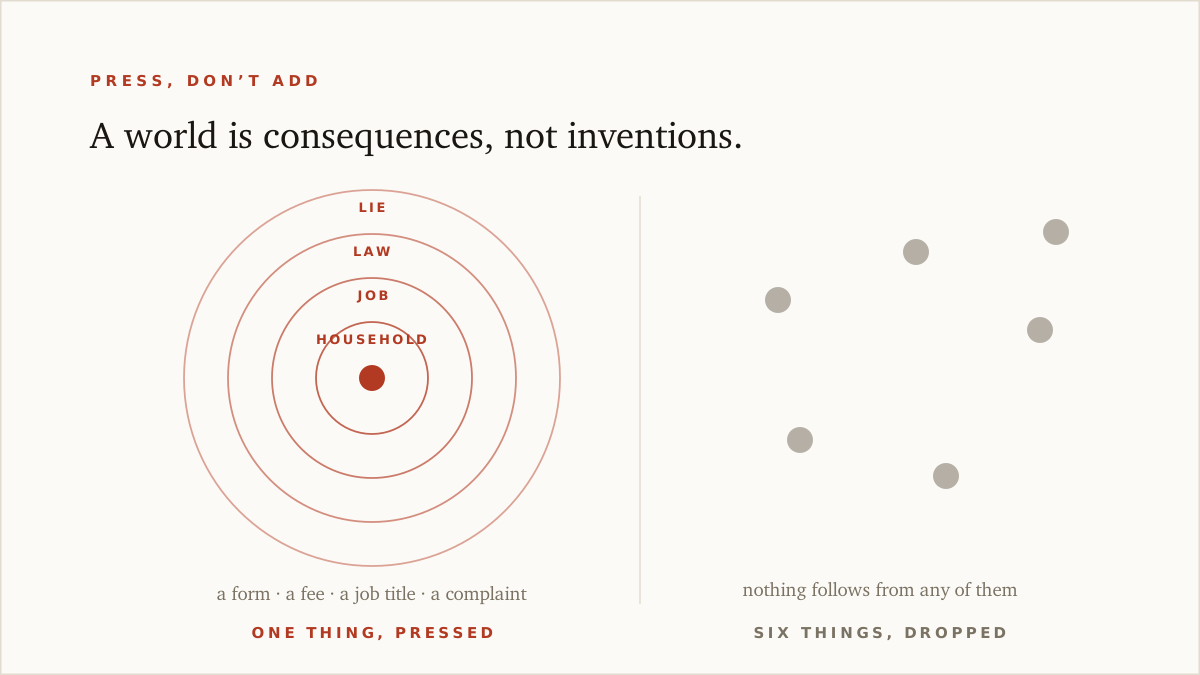
This is the central argument of How to Write Speculative Fiction, the short guide to one impossible thing and everything that follows. Every chapter ends with the Ripple, a test you run on your own draft, and one novel-in-progress is diagnosed and repaired across the whole book.
The note comes back as a feeling rather than a fault. It didn't feel fully realised. The world seemed thin. I wanted more of it.
So you add more of it. A second order of magic alongside the first. A rival faction. Four hundred years of history in a document nobody will read. The manuscript gets longer, the note comes back unchanged, and now there is more of a thing that was not working.
Here is the counterintuitive part, and it is the single most useful idea I know about writing this kind of book.
A world does not feel thin because it contains too few invented things. It feels thin because the invented things have no consequences.
What readers mean by "realised"
A reader cannot audit your world. They have no way of knowing whether you have four hundred pages of notes or none.
What they can detect is whether the strange thing has touched anything. Whether it has altered a household, complicated a job, produced a law, embarrassed somebody, made a particular kind of person rich and a particular kind of person obsolete. Whether anyone has learned to cheat at it.
A single departure with twenty consequences reads as an entire world. Five departures with no consequences read as set dressing, no matter how inventive they are — and inventiveness without consequence is, from the reader's side, indistinguishable from randomness.
Press, don't add
So the instruction is to go the other way. Find the one departure the story cannot exist without, and press it until it gives you things.
Say the departure is this: for one hour after a death, the dead can be spoken to.
The thin version puts that in a book and uses it for one extremely good scene.
The pressed version asks what else is true.
Somebody is on call for that hour, and it is a job, and it is paid badly. There is a form. Hospitals have a room for it and the room has a name that staff use with a particular dryness. Families fight about who gets the hour, and the fight is not about love, it is about money, because a will can be contested on the strength of what was said. Someone has worked out how to fake a recording. There is a religion that refuses the hour on principle and its adherents are considered either admirable or insane depending on who you ask. There are people who missed it — arrived late, were in another country — and they have a particular look, and the book's protagonist can recognise them in a room.
None of that is a second impossible thing. It is all the first one, followed honestly.
That is the difference between a premise and a world.
Where to press
Four directions, and they get progressively more useful.
The household. What does this change about an ordinary evening? Not a dramatic evening. A Tuesday.
The job. Somebody administers this thing, and they are bored by it. What is their shift like? Who do they resent?
The law. Whatever your departure is, somebody has tried to use it to get money or avoid blame, and there is now a rule about that. Rules are the fastest way to make a reader believe a world has been lived in.
The lie. This is the richest and the most skipped. What would people lie about, under these conditions? What is now possible to get away with, or impossible to hide? A society's characteristic lie tells a reader more than its characteristic landscape.
Aim it at the person, not just the world
One more move, and it is what separates a well-built world from a novel.
The consequences should land on your protagonist's existing wound. Not a different, interesting character — the one whose book this is.
If your departure is the hour with the dead and your protagonist is a woman who never said the thing to her mother, the premise and the character are one story and every scene does both jobs at once. If your protagonist is a detective investigating hour-fraud and the wound is unrelated, you have a good procedural with a strong gimmick, and the book will feel like two books politely sharing a cover.
Readers describe that split as the world feeling "separate from the story", which is another phrase for not fully realised.
The test
On one page, write your departure in a single sentence. Under it, list ten consequences, of which at least four must be boring — a form, a fee, a job title, a complaint.
If you can fill the page, your world is built, whatever its page count.
If you cannot get past four, do not add a second impossible thing. Keep pressing the one you have.
The book this came from
How to Write Speculative Fiction
The guide goes on to the parts that are harder than the premise: aiming the departure at your protagonist's deepest wound, explaining a world without info-dumps, why the magic must never solve what the character should, and how to pitch the result.
Kindle