Your Co-Author Wakes Up a Stranger Every Morning
Around chapter fourteen the housekeeper's name quietly changes. Here is the document that prevents it, and why it is not world-building homework.
This is one of the two documents the method in The Four-Day Novel is built on — the honest book about writing fiction with AI. The other is the style sheet. Together they are what stop a model inventing your book out from under you, and the book walks through building both, plus the drafting loop that uses them and an annotated prompt library.
Somewhere around chapter fourteen of your first AI-assisted novel, if you skip this, the following things happen.
The housekeeper, established as Agnes, quietly becomes Agatha. The roof leak, so far confined to Room 7, migrates to Room 3. Your heroine's dead father is alive, briefly, in a line of dialogue about calling her parents. And a character who drove a gray truck in chapter three climbs out of a blue one — unless he is climbing out of it with the arm he lost in chapter nine, in which case he has that back too.
None of this is the machine being careless.
It is the machine being what it is: a co-author with no memory.
The amnesiac problem
Between sessions — and past a certain distance, even within one — your co-author retains nothing about your book. Not the names, not the geography, not who knows which secrets. Every drafting request starts from amnesia.
And here is the part that makes it dangerous rather than merely annoying: whatever the amnesiac is not told, it invents, fluently and confidently, because inventing fluent text is its entire nature. It will not stop and ask what color the truck was. It will pick one.
A human collaborator misremembers occasionally. This one cannot remember at all, and the difference demands a different tool.
The tool is a story bible: a structured document that holds everything true about your book, maintained outside the machine and fed back to it in slices, chapter after chapter.
Series writers already keep something like it. Television writers' rooms live and die by theirs. But for a human, a bible is a backup for memory. For your co-author it is the memory. The entire long-term truth of your novel exists in exactly one place, and you are its custodian.
That reframing matters, because writers hear "story bible" and picture world-building homework — the hundred-page lore binder for a fantasy trilogy. Yours is not homework and mostly is not lore. It is a working technical document with one job: to make sure the machine can never invent what has already been decided. Everything earns its place by that test.
What goes in it
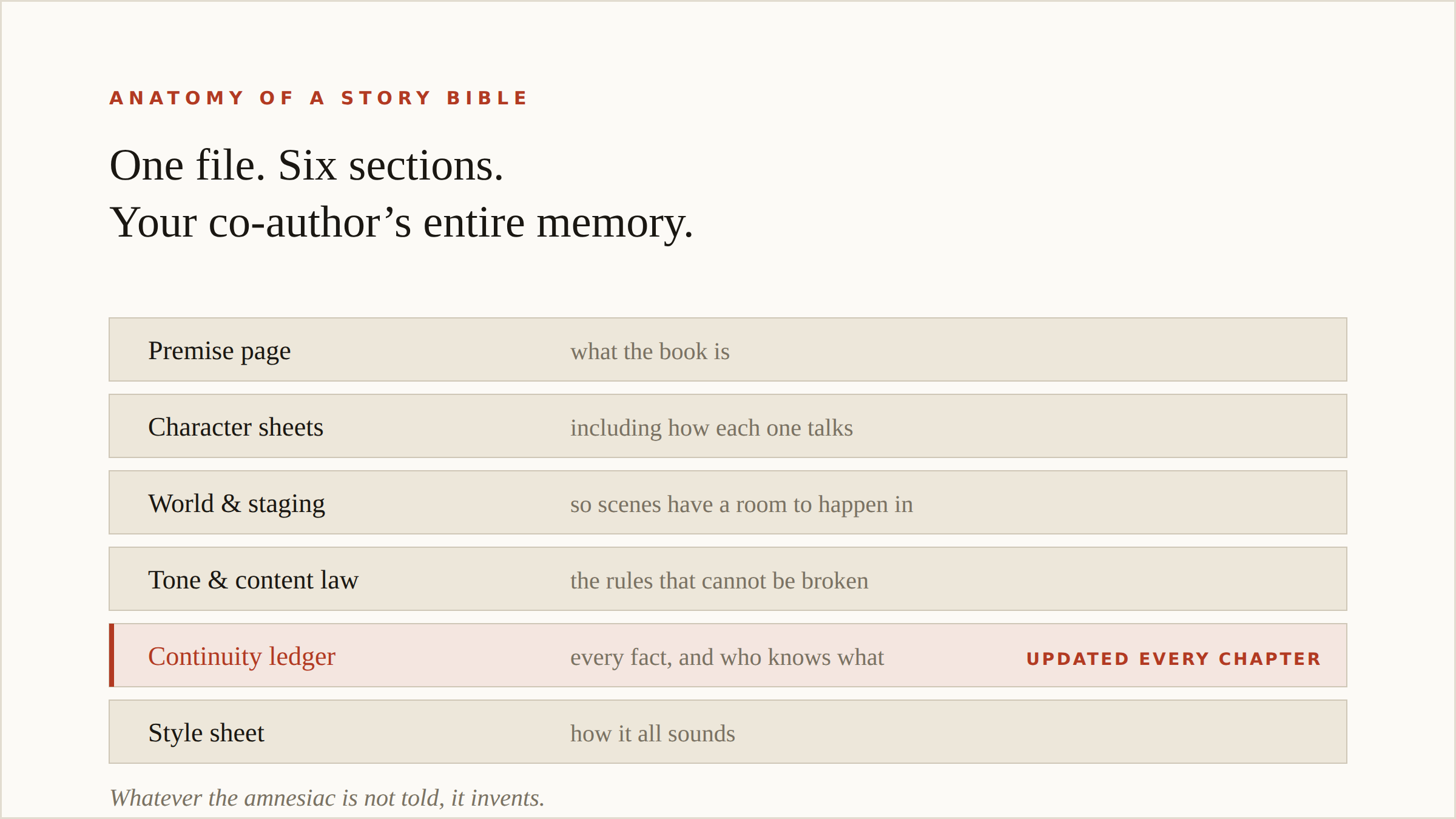
Six sections.
The premise page. Your logline and a one-page synopsis. Its job is orientation — it heads every context package so the machine drafts each scene knowing what story the scene serves.
Character sheets. One per named character who appears more than twice. Physical description, because the machine will otherwise re-invent hair, age and height per chapter. Role and goal. Motivation and the wound behind it. Backstory in a paragraph. Relationships to the other principals, stated bluntly. A habit the prose can reach for.
And the field beginners always skip and always regret: dialogue style. Left unspecified, every character in machine prose speaks the same smooth, articulate, faintly therapized dialect, because that is the average of all dialogue ever written. Two lines break the spell:
Short sentences, trade vocabulary, allergic to abstractions. Deflects feeling into tasks — "You eaten?" instead of "I was worried". Never raises his voice; goes quieter when angry. Teases by understatement. Will not say her name when upset; says "you".
Forty words. It buys a character who sounds like himself for four hundred pages.
World-building — yes, even in a contemporary novel. Strip the word of its dragons. This is every fact about the physical and social world: the layout of the building, the geography of the town, who runs what, what the institutions can and cannot do.
Two reasons the machine needs it. Consistency, obviously. But also blocking — the floating-heads problem, where two characters talk for a page and no bodies or objects exist, is half-solved by giving the machine a proper room to stage the scene in. A prompt that includes "the kitchen: farmhouse table seats eight, wood stove, door to the garden, recipe boxes on the sill" gets back a scene where hands have things to do.
Tone and content rules. The book's operating law. Point of view and tense. Heat level. Language ceiling. Violence ceiling. The genre promises that must not be broken. These exist because the machine, sampling from everything ever written, will otherwise wander across registers — a stray curse in a sweet romance, a sudden lyrical mode in lean prose. The law page keeps it in jurisdiction.
The continuity ledger. The living heart of the bible, and the section that does not exist until you start drafting.
The style sheet. Already built, if you did that first. It lives here as its own section and travels with every prompt.
The ledger, and the who-knows-what column
The ledger is a running, chapter-stamped record of every fact the book establishes as it goes. Dates and elapsed time. Weather. Injuries. Objects and where they ended up. Revelations — and crucially, who knows what.
Secrets are where continuity errors humiliate authors, and the mechanism is specific. The machine knows the truth of the plot, because you told it in the premise. So it will casually hand that truth to a character who has not learned it yet.
In an early drafting loop on the sample project the book is built around, the machine had the housekeeper reference "that Cardwell business" a full chapter before the protagonist tells anyone about the offer. Nothing in the prose flagged it. The line read perfectly naturally, which is exactly the problem — a continuity error that sounds wrong is one you catch, and a continuity error that sounds fine is one that ships.
Only a ledger entry riding in the prompt — she knows, the town does not, yet — prevents that class of leak. And only your edit, checking against the same entry, catches the ones that slip through anyway.
A ledger entry costs about ninety seconds per chapter. Three chapters in, it looks like a shopping list. By chapter thirty it is the most valuable page in the project.
Building the first draft with the amnesiac's help
Here is the pleasant irony: the machine that makes the bible necessary is also excellent at drafting it. Hand it your story dossier and ask it to expand each named character into a full sheet and each location into an entry, using the field structure above. Ten minutes later you have a complete first-draft bible.
You will also have a generic one, and by now you should recognize the pattern: the machine's draft regresses to the mean, and the correction pass is where the book becomes yours.
Expect the defaults. The love interest comes back brooding, with a tragic dead wife and a jaw that clenches, because the machine has read ten thousand of him and hands you their average. The older woman is twinkly-eyed and dispenses cookies and wisdom. The town acquires a diner called Rosie's and a festival, genre-issue, one each.
Go through every sheet and strike the clichés, replacing them with choices. The version I would defend: he lost a business, not a wife — his contracting firm went under, which is why he now works for a developer he half-despises, which is what makes his position genuinely hard instead of decoratively brooding.
That correction takes two minutes and is worth more than any prompt.
One technique deserves its own paragraph, because it is the single best bible-building move I know: make the machine interview you. After the correction pass, ask it to read the bible so far and put to you, one at a time, the ten questions whose answers would most improve the character sheets. Then answer in your own words and fold the answers in.
The questions it asks are rarely brilliant. The answers they pull out of you frequently are. Asked what a character does with her hands when she is lying, I found out she straightens things — menus, cutlery, other people's collars — which became a running physical motif for four hundred pages. You know things about your characters that you do not know you know. Interrogation is how they surface, and the amnesiac never gets tired of asking.
The two ways a bible fails
Too thin, and the machine invents. Every undecided fact is an invitation. No dialogue style means default dialect. No town geography means the hardware store teleports. The test: will the book ever state or depend on this fact? If yes, decide it and write it down.
Too fat, and you drown the prompt. The bible is a reference library, not a payload. Each drafting prompt should carry only the slices the scene needs — the two characters in the room, the one location, the ledger, the law, the style sheet. Feed the machine thirty pages for a two-person kitchen scene and you have diluted its attention across twenty-eight irrelevant ones, and the first casualties are exactly the fine-grained behaviors you specified so carefully.
So the fat failure is not really writing too much. It is writing entries so long and novelistic that they cannot be sliced. Character sheets under a page. Locations in a paragraph. The bible is written for a machine to consume, and machines consume specifications, not literature.
In one line: decide everything the book depends on, record it as tersely as truth allows, slice it per scene.
Name what does not belong, too, because the fat failure usually arrives disguised as diligence. Theme essays do not belong; the machine cannot obey an abstraction. Research dumps do not belong; four fascinating pages compress to the three facts the book will actually state. And deliberations do not belong — the bible records what is true, not what is under consideration. The moment a maybe enters it, the amnesiac treats it as canon, because it has no way to hold anything at arm's length.
Decisions in the bible. Deliberations anywhere else.
The one rule
The bible is updated at the end of every chapter cycle, before the next chapter is drafted. No exceptions.
Every chapter you draft and edit establishes facts — some from your outline, plenty invented during drafting and kept because they were good. The moment those facts exist on the page they are canon, and canon that lives only on the page is canon the amnesiac will violate. Ninety seconds with the ledger converts page-canon into bible-canon, and bible-canon is enforceable: it rides into the next prompt, and the next, for the rest of the book.
Skip it for three chapters and you will get away with it. Skip it for ten and the debt comes due all at once, in a scene where Agatha pours coffee in the wrong room for a man with the wrong truck — and now you are reverse-engineering your own book to find out what is true in it.
The ledger is cheaper. It is always cheaper.
There is a quieter benefit as well. Maintaining it forces you to notice what each chapter established, which is a low-grade continuous developmental read of your own book. A chapter that adds nothing to the ledger has usually added nothing at all.
The bible starts as the machine's memory. It ends up sharpening yours.
The book this came from
The Four-Day Novel
Chapter 5 of the book builds the bible in full, with the field structure for character sheets, the continuity ledger format, and the prompts that draft it for you. Chapter 8 is the loop that consumes it — how to slice the bible per scene so the machine gets exactly what the chapter needs and nothing else.
Kindle · Paperback · included in Kindle Unlimited