If the prose is lovely and the book is still
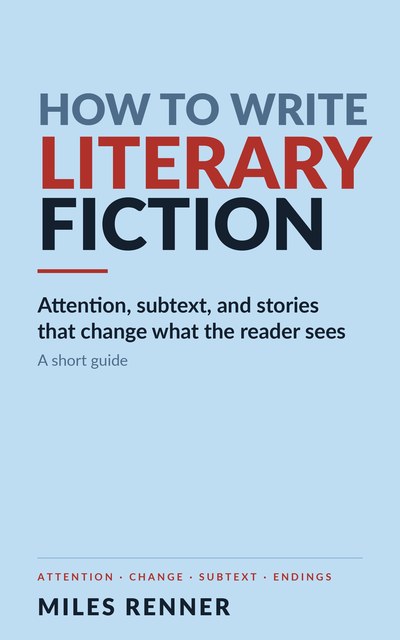
How to Write Literary Fiction
Attention, Subtext, and Stories That Change What the Reader Sees
Your sentences are beautiful. So why do agents keep calling your novel quiet?
Kindle
Most writers are taught that literary fiction is fiction in which prose and character matter more than plot. That definition is half right, and it does real damage.
It gives writers permission to write books in which nothing happens — and then, when the book stalls, it sends them back to polish sentences that were never the problem.
The deal
A literary novel makes a deal with its reader: attention in exchange for change. The reader agrees to follow a mind closely, at a pace no thriller would permit. In return, something has to move. Not necessarily events — but what the protagonist understands.
The plot of a literary novel is the movement of understanding. Once you can see it that way, the two ways literary manuscripts break the deal become obvious, and they are opposites: the beautiful stall, where nothing shifts, and the disguised message, where everything shifts because the author decided in advance what the reader should learn.
Where the turn lives
The movement is made of belief events — the moments where what a character holds to be true stops holding. They are almost always already in your draft, unmarked and underweighted. The book shows you how to find them and how to make them count, and gives you four shapes they take: the slow turn, the reversal, the recognition, and nonlinear time.
Also in here
- Point of view as a way of noticing — and why generic observation makes a book feel still even when the sentences are good.
- Precision versus ornament: where to put your best sentences, which is where the book turns.
- How subtext is actually built, and the explaining habit that kills it.
- The difference between an open ending and an unfinished one.
- Comps, literary magazines, small presses, and an honest look at self-publishing literary fiction.
One manuscript, all the way through
The Winter Tenant runs the length of the book — a novel about a retired piano teacher, her late husband, and a lodger who may not be who he says he is. Its prose is excellent and its story is still. You see exactly why, and two very different ways to fix it.
Every chapter ends with a test, not a rewrite, built on one idea: a literary scene should mean more the second time through. All eight collect onto a single page at the back, so you can run them against a whole draft.
Short, practical, and honest about the market — for every writer who has been told their writing is lovely and wondered why that wasn’t enough.
“A literary novel makes a deal with its reader: attention in exchange for change.”
What’s inside
- Why “character over plot” stalls so many manuscripts, and the two ways literary novels break their promise: the beautiful stall and the disguised message.
- How to find the belief events already hiding in your draft, and make them count.
- Four shapes of understanding — the slow turn, the reversal, the recognition, nonlinear time — and where the turn belongs.
- Point of view as a way of noticing, and why generic observation makes a book feel still.
- Precision versus ornament, and how to put your best sentences where the book turns.
- How subtext is built, and the explaining habit that kills it.
- The difference between an open ending and an unfinished one.
- Comps, literary magazines, small presses, and an honest look at self-publishing literary fiction.
Who it's for
- You have been told your writing is lovely, and it hasn’t been enough.
- Agents and readers call the book “quiet” and you can’t tell what they mean by it.
- You write close, interior fiction and want it to move without turning into a plot novel.
Who it isn't for
- You want prose exercises. The sentence chapter is about placement, not polish.
- You are looking for a definition of literary fiction to quote. The definition is what this book replaces.
- You have no draft yet — the tests need pages to run on.
Questions
What is literary fiction?
Fiction that trades attention for change: the reader agrees to follow a mind very closely, and in return something has to move — most often what the protagonist understands rather than what happens to them. The common definition, “prose and character over plot,” describes the texture and leaves out the obligation, which is why it produces beautiful manuscripts that stall.
Why do agents call my novel “quiet”?
Usually because nothing in the protagonist’s understanding moves, or it moves so gradually that no single scene carries the shift. It is rarely a verdict on your sentences. The fix is to find the belief events already in the draft — the moments where something a character holds to be true stops holding — and give them the weight and placement they need.
What is the difference between literary and upmarket fiction?
Upmarket fiction also closes a plot question that keeps the pages turning; literary fiction is under no such obligation. If your book has both a question that closes and one that stays open, you may be writing upmarket — which has its own guide in this series.
How do you write subtext?
By building the gap between what a scene shows and what it means, and then resisting the habit that closes it — explaining. The subtext chapter is mostly about that habit, because most drafts have the subtext already and then spend a paragraph dismantling it.
Can literary fiction be self-published?
The last chapter covers comps, literary magazines and small presses, and then takes an honest look at self-publishing literary fiction — including where the economics and the discovery problem are genuinely harder than they are in genre.
Is there a test I can run on my own draft?
One at the end of every chapter, built on a single idea: a literary scene should mean more the second time through. All eight are collected on one page at the back so you can run them against a complete manuscript.
How to Write Literary Fiction
A literary novel makes a deal with its reader: attention in exchange for change. The reader agrees to follow a mind closely. In return, something has to move — not necessarily events, but what the protagonist understands.
Kindle